Blog

Swot Analysis of Infosys

SWOT Analysis of Infosys Company

Infosys, one of India’s most iconic IT giants, stands tall as a global leader in technology services and consulting. Founded in 1981 by visionary entrepreneur N.R. Narayana Murthy, the company has grown from a modest startup into a multi-billion-dollar enterprise with a strong international footprint. Today, Infosys is renowned for its innovative solutions, cutting-edge technologies, and commitment to sustainability, helping clients around the world navigate their digital transformation journeys.

Conducting a SWOT analysis of Infosys company allows us to evaluate its strategic position by assessing its Strengths, Weaknesses, Opportunities, and Threats. This comprehensive analysis offers critical insights into how Infosys can maintain its competitive edge in the dynamic global IT industry.

Company Snapshot

  • Founded: 1981 by N.R. Narayana Murthy
  • Headquarters: Bangalore, India
  • Global Presence: Operations in over 50 countries
  • FY 2023-24 Revenue: $17.5 billion
  • Infosys Employee Strength: Over 350,000 globally

Over the years, Infosys has built a strong brand by delivering value across diverse sectors, including banking, healthcare, manufacturing, and retail. With over 350,000 employees spread across continents, the company boasts a diverse and skilled talent pool that drives innovation and delivers exceptional service to its clients.

SWOT Analysis of Infosys

Strengths

 Robust Global Brand Reputation

Infosys has earned a solid reputation over the decades as a reliable IT service provider. Its consistent quality, timely project delivery, and client-focused approach have built immense trust among global clients. The brand is recognized for innovation and operational excellence.

Example: Infosys’ recognition as a Leader in Gartner’s Magic Quadrant for IT Services highlights its consistent delivery and strategic vision in the global market.

 Diverse Service Portfolio

 Infosys offers a wide range of services—Artificial Intelligence, cloud, blockchain, cybersecurity, IoT, data analytics, and digital commerce—allowing it to serve multiple industries from healthcare and banking to retail and manufacturing. This diversification reduces risk and boosts revenue stability.

Example: Infosys partnered with Rolls-Royce to provide engineering services, leveraging its digital capabilities to optimize aerospace operations.

Strong Financial Performance

 Infosys has maintained healthy financials with $17.5 billion in revenue in FY 2023–24, reflecting efficient operations, strategic investments, and high shareholder returns. It consistently delivers double-digit profit margins and remains fiscally conservative.

Sustainability and Innovation Commitment

 Infosys is a global leader in IT sustainability. It was among the first IT companies to achieve carbon neutrality and continues to invest in digital labs, R&D, and AI automation platforms, driving sustainable innovation.

Example: Infosys’ AI-driven digital agriculture platform, in collaboration with India’s Ministry of Agriculture, demonstrates how tech can address food security and sustainability.

 Experienced Leadership and Skilled Workforce

Led by Salil Parekh, Infosys has embraced digital transformation and global expansion. Its workforce of over 345,000 includes specialists in cloud, AI, engineering, and consulting—enabling it to tackle complex client challenges.

Example: During the COVID-19 pandemic, Infosys swiftly deployed remote work solutions and digital infrastructure for global clients like Siemens and Vanguard, showing agility and deep talent capabilities.

Weaknesses

High Dependence on North American Market

Around 60% of Infosys’ revenue comes from North America, making it vulnerable to economic fluctuations, visa restrictions, and geopolitical risks in that region.

Example: Changes in the H-1B visa policy during the Trump administration had impacted hiring and resource deployment, highlighting overdependence on one geography.

Elevated Employee Attrition Rates

 Infosys faces high attrition, especially among experienced mid-level managers and niche tech experts, which affects project continuity and knowledge retention, despite its investments in learning platforms like Lex.

Example: In FY 2022–23, Infosys reported attrition rates exceeding 20%, prompting it to increase employee engagement initiatives and compensation adjustments.

Integration Challenges Post Acquisitions

While acquisitions like WongDoody (creative services) and GuideVision (ServiceNow consultancy) enhanced Infosys’ capabilities, integrating them culturally and operationally has sometimes delayed synergies and slowed down value realization.

Opportunities

Global Demand for Digital Transformation

 Digital-first business models are now essential. Infosys can offer automation, cloud migration, and AI-driven innovation to global firms undergoing transformation.

Example: Infosys helped Daimler AG build a hybrid cloud system, improving operational flexibility and showcasing its role in enterprise digital journeys.

Expansion in Emerging Markets

Africa, Southeast Asia, and Latin America offer underpenetrated IT services markets. Infosys can expand operations, offer localized solutions, and grow its brand in these regions.

Example: Infosys launched a digital innovation hub in Brazil, reflecting its move toward tapping into Latin American talent and market demand.

Strategic Alliances

Partnerships with tech giants like Google Cloud, AWS, and Microsoft Azure allow Infosys to enhance its digital solutions portfolio and stay competitive in a fast-evolving tech environment.

Example: Infosys and Microsoft collaborated to accelerate enterprise cloud adoption for global retail firms, enabling modernized infrastructure and customer-centric services.

Threats

Intense Market Competition

The IT services market is saturated. Infosys competes with heavyweights like TCS, Accenture, Wipro, IBM, and HCL. Pricing pressure and client acquisition costs are rising.

Example: Accenture’s aggressive push into AI consulting has directly challenged Infosys in Europe and North America, forcing faster innovation.

Technological Disruption

The rapid evolution of technologies like quantum computing, generative AI, and low-code platforms means Infosys must continuously upskill talent and evolve offerings or risk losing market relevance.

Example: The rise of OpenAI’s ChatGPT and Microsoft’s Copilot has disrupted traditional software engineering models, necessitating a major shift in IT services.

 Regulatory Challenges

Operating across multiple countries, Infosys faces varied tax laws, data privacy regulations (like GDPR and India’s DPDP Act), and labor compliance norms, which can impact its global operations.

Example: Data localization laws in the EU required Infosys to build local data centers, increasing compliance costs and operational complexity.

Competitive Landscape

Infosys operates in a highly competitive IT services industry and ranks consistently among the top three Indian IT firms by revenue and client satisfaction.

  • TCS (Tata Consultancy Services): The largest IT firm in India, TCS has deeper global penetration, vast scale, and a wider service base. It is Infosys’ closest rival.

    Example: TCS secured a $2 billion deal with BSNL, outshining competitors including Infosys.
  • Accenture: Known for its consulting-driven approach, Accenture has a stronger presence in strategic transformation and innovation advisory.

    Example: Accenture’s acquisition of over 40 companies in the digital space in one year gives it a strong innovation edge.
  • Wipro & HCL Technologies: These Indian firms offer similar services and are rapidly expanding in AI, cloud, and cybersecurity, posing a growing threat.
  • IBM: A traditional IT and consulting powerhouse focusing heavily on hybrid cloud, AI (with WatsonX), and enterprise digital solutions.

Competitors of Infosys Company

Infosys operates in a highly competitive global IT services landscape, with several major players offering similar services in areas like digital transformation, IT outsourcing, cloud solutions, and consulting. Let’s explore Infosys’ top competitors, how they compete, and see real-world examples of their impact:

 Tata Consultancy Services (TCS)

TCS is Infosys’ biggest domestic rival and India’s largest IT services firm. With a massive global presence, TCS offers end-to-end IT services, just like Infosys.

  • Example: TCS partners with Jaguar Land Rover to develop software-driven automotive platforms, directly competing with Infosys’ auto-sector digital solutions.

Wipro

Wipro is another Indian IT giant that mirrors Infosys in its focus on cloud computing, cybersecurity, and AI-powered transformation services.

  • Example: Wipro’s deal with Metro AG, a German wholesaler, to manage its IT operations competes with Infosys’ contracts with global retail brands.

HCL Technologies

HCL is known for its strong engineering and R&D services, making it a tough competitor for Infosys in niche tech services and innovation-led transformation.

  • Example: HCL provides engineering services for Boeing, an area Infosys also targets through its engineering division.

Tech Mahindra

Specializing in telecom and digital transformation, Tech Mahindra overlaps with Infosys in multiple sectors including manufacturing, banking, and healthcare.

  • Example: Tech Mahindra’s partnership with AT&T for 5G transformation puts it in direct competition with Infosys’ telecom digital offerings.

Accenture

A global powerhouse, Accenture offers consulting, technology, and outsourcing services. It is a major rival to Infosys, especially in high-end consulting and cloud transformation.

  • Example: Accenture helped Unilever migrate to the cloud, similar to Infosys’ work with ABN AMRO Bank on digital transformation.

Capgemini

This French multinational is a major competitor in Europe, where Infosys is trying to expand. Capgemini blends IT services with engineering and consulting.

  • Example: Capgemini’s work with Renault Group on smart vehicle software competes with Infosys’ own projects in the automotive space.

Cognizant

Originally founded in India, Cognizant is now U.S.-based and competes heavily in the North American market, especially in healthcare, life sciences, and BFSI sectors.

  • Example: Cognizant’s long-term partnership with Humana (a U.S. healthcare insurer) overlaps with Infosys’ work with US-based Anthem.

IBM

Though traditionally a hardware giant, IBM’s strong consulting and cloud service offerings—especially after acquiring Red Hat—make it a significant competitor.

  • Example: IBM’s hybrid cloud solutions for Delta Airlines compete with Infosys’ cloud migration services for major airlines and logistics firms.

DXC Technology

DXC focuses on enterprise IT modernization and digital transformation services. It often competes in public sector and legacy system modernization projects.

  • Example: DXC’s digital contract with the U.S. Department of Defense parallels Infosys’ work with global government and public sector units.

Strategic Recommendations

Diversify Revenue Streams

Infosys currently derives nearly 61% of its revenue from North America, making it vulnerable to regional economic or regulatory changes. To achieve long-term financial stability, it must focus on expanding its client base in Asia, Europe, and Africa, where digital transformation is gaining momentum.

 Example: Infosys recently opened new Digital Innovation Centers in Düsseldorf, Germany, and Melbourne, Australia, which serve as regional hubs for digital services and client engagement. Expanding such centers in Africa (e.g., Kenya or South Africa) could help tap into new markets and reduce geographic concentration risk.

Enhance Employee Engagement

High employee attrition remains a pressing concern in the IT sector, including at Infosys. The solution lies in building a more supportive and flexible work culture that includes:

  • Structured career growth plans
  • Flexible/hybrid work arrangements
  • Accessible mental health support

Example: Infosys’ Lex Learning Platform, which offers personalized learning paths for upskilling employees, is a great initiative. However, more proactive strategies like Google’s “20% Time”—allowing employees to work on personal innovations—could boost morale and retention. Additionally, TCS’s Elevate program for fast-tracking careers has set an industry benchmark Infosys can emulate or enhance.

Invest in R&D and Innovation

To maintain its leadership in tech services, Infosys must double down on emerging technologies such as AI, blockchain, quantum computing, and automation. This means expanding its innovation labs, forming strategic alliances, and funding cutting-edge projects.

 Example: Infosys has already launched Infosys Topaz, a generative AI-powered suite for transforming business operations. To go further, Infosys can follow IBM’s Q Network initiative in quantum computing, which brings together academia and enterprise clients for collaborative research. Similarly, Wipro Holmes (an AI platform) shows how strategic focus on automation can be monetized at scale.

Strengthen M&A Integration Frameworks

Infosys has faced challenges in extracting value from acquisitions like Panaya and Skava. These issues highlight the need for a streamlined and culturally sensitive integration process to maximize synergy and prevent operational disruptions.

 Example: Infosys can take cues from Accenture, which has a specialized M&A Integration Services Team responsible for ensuring that acquired firms blend seamlessly into the parent organization. Infosys should develop similar internal protocols, including a 100-day integration checklist, leadership alignment programs, and dedicated change management teams to ensure a smooth transition.

Conclusion of Infosys

 The SWOT analysis of Infosys company reveals a resilient and strategically sound enterprise with strong foundations in innovation, ethics, and performance. While it faces some internal and external challenges, Infosys has the vision and capability to overcome them through smart strategies. By investing in talent, exploring new markets, and embracing technological evolution, Infosys can continue its legacy of excellence.

Infosys’ journey from a small Indian startup to a global IT powerhouse is a testament to the strength of its vision and values. As it navigates the complexities of the digital age, the company remains committed to delivering sustainable value to stakeholders worldwide.

FAQs of Infosys Company

Q1: When was Infosys founded? A: Infosys was founded in 1981 by Narayana Murthy and six other co-founders.

Q2: What is the employee strength of Infosys? A: As of FY 2023-24, Infosys has over 350,000 employees globally.

Q3: What services does Infosys offer? A: Infosys offers services in AI, cloud computing, cybersecurity, IoT, digital transformation, and consulting.

Q4: What are Infosys’ main markets? A: The main market for Infosys is North America, contributing around 60% of its revenue.

Q5: Who are Infosys’ main competitors? A: Infosys’ main competitors include TCS, Accenture, Wipro, HCL Technologies, and IBM.

Q6: What are some challenges Infosys faces? A: Infosys faces challenges like high attrition, integration of acquisitions, and dependence on the North American market.

Q7: What are the key opportunities for Infosys? A: Key opportunities include global digital transformation demand, expansion into emerging markets, and strategic partnerships.

Q8: What is the conclusion of Infosys SWOT analysis? A: The conclusion of Infosys SWOT analysis is that while Infosys is a strong global IT leader with a diverse portfolio and innovation-driven mindset, it must continue to address internal and external challenges to sustain long-term growth.

Q9: What are Infosys’ key areas of service? A: Infosys offers services in AI, cloud computing, cybersecurity, data analytics, enterprise solutions, and IT consulting.

Q10: How has Infosys performed financially in recent years? A: Infosys reported $17.5 billion in revenue in FY 2023-24, maintaining strong profitability and growth momentum.

Q11: What makes Infosys stand out in the IT industry? A: Infosys stands out for its ethical governance, sustainability initiatives, innovative technologies, and global delivery excellence.
 

Swot Analysis of Dabur

SWOT Analysis of Dabur India

Dabur India is one of the most renowned and respected names in the fast-moving consumer goods (FMCG) sector, known for its extensive range of Ayurvedic and natural products. With a legacy spanning over a century, the company has carved a unique niche in the market, offering trusted healthcare, personal care, home care, and food products. In this blog, we will conduct a comprehensive SWOT analysis of Dabur, exploring its strengths, weaknesses, opportunities, and threats, along with real-life examples, market insights, and strategic recommendations to highlight its growth potential.

Company Overview

Present CEO Mr. Mohit Malhotra
Year of Establishment 1884
Annual Revenue (FY24) Rs. 12,404.01 crore
Net Profit (FY24) Rs. 1,843 crore
Origin Ghaziabad, Uttar Pradesh
Type of Company FMCG
Total No. of Employees 7,500
Total Assets (FY24) Rs. 15,123 crore
Market Capitalization (FY24) Rs. 35,000+ crore (approx.)
Number of Products 250+
Export Presence 120+ countries
R&D Facilities Multiple across India
Stock Exchange Listing NSE, BSE
Key Business Segments Healthcare, Personal Care, Foods

Founded in 1884 by Dr. S.K. Burman, Dabur India Limited is one of India’s oldest and largest FMCG companies. Initially established to provide effective Ayurvedic medicines for common ailments, Dabur has grown into a global brand with a presence in over 100 countries. It operates across various segments, including:

  • Healthcare: Dabur Chyawanprash, Dabur Honey, Dabur Honitus
  • Personal Care: Dabur Amla, Vatika Hair Oil, Meswak Toothpaste
  • Home Care: Odomos, Odonil, Sanifresh
  • Foods: Real Fruit Juices, Hommade range of pastes and purees

The company’s vision is to “dedicate itself to the health and well-being of every household,” and it continues to focus on leveraging its Ayurvedic expertise to create innovative products that meet modern consumer needs.

Strengths of Dabur India

 Strong Brand Equity

 Dabur is one of India’s most trusted brands, deeply associated with Ayurveda and natural wellness. Its strong brand equity is a result of its rich heritage, consistent quality, and commitment to health-focused products.

 For example, Dabur Chyawanprash, a traditional Ayurvedic health supplement, holds a dominant market share and is a staple in Indian households during winter for its immunity-boosting properties. This deep-rooted trust has helped Dabur build unparalleled customer loyalty over generations.

 Diverse Product Portfolio 

Dabur boasts a diversified product portfolio that spans multiple categories, including health supplements, personal care, home care, and foods. This diversification reduces its dependency on a single product line and spreads business risk.

 For instance, Dabur Honey leads the Indian honey market, while Real Fruit Juices are highly popular in the packaged beverage segment. This wide-ranging portfolio allows Dabur to cater to varied customer needs, enhancing its market presence.

Extensive Distribution Network 

Dabur has a robust distribution network covering over 6.7 million retail outlets globally. This extensive reach enables it to penetrate both urban and rural markets effectively, giving it a competitive edge over many FMCG players.

 For example, its strong rural distribution network allows products like Dabur Lal Tail and Dabur Amla Hair Oil to reach remote areas where competitors often struggle.

Research and Development (R&D) Focus

 Dabur’s commitment to innovation is evident in its significant investments in R&D. The company continually introduces new products that align with consumer preferences for natural and health-oriented solutions.

 For instance, Dabur’s R&D centers have developed successful products like Dabur Red Paste, which blends Ayurvedic knowledge with modern science, and Vatika Hair Oil, known for its herbal formulations. This R&D focus keeps Dabur at the forefront of natural wellness.

 Sustainability Initiatives 

Dabur is committed to reducing its environmental footprint through various sustainability initiatives. It has invested in renewable energy, water conservation, and plastic waste reduction, reinforcing its image as a responsible corporate citizen. 

For example, Dabur’s ‘Plastic Waste Management Initiative’ aims to become a plastic waste neutral company by 2025.

Weaknesses of Dabur India

 High Dependency on Rural Markets

 A substantial portion of Dabur’s revenue comes from rural India, making it vulnerable to fluctuations in agricultural income and weather-dependent economies.

 For instance, poor monsoons or crop failures can directly impact consumer spending in rural areas, affecting Dabur’s sales.

 Price Sensitivity 

Dabur’s products often face stiff price competition from both organized and unorganized players, which can impact its profit margins.

 For example, brands like Patanjali and local Ayurvedic startups often offer similar products at lower prices, creating pricing pressure.

Limited Presence in Premium Segments 

Despite its strong brand equity, Dabur has a relatively smaller share in premium health and personal care segments, where brands like Himalaya and Forest Essentials have established themselves. This limits its appeal to high-end consumers seeking luxury wellness products.

 Regulatory Challenges 

As a major player in the Ayurvedic and natural products space, Dabur must navigate complex regulatory environments that can impact product approvals and market entry. 

For example, Ayurvedic products are subject to various licensing and quality control norms, which can delay product launches.

Opportunities for Dabur India

Expansion into New Markets 

The global demand for natural and organic products presents a significant opportunity for Dabur to expand internationally. 

For instance, the rising interest in Ayurveda in Western markets provides a promising growth avenue.

Digital Transformation 

With the rapid shift towards e-commerce, Dabur has an opportunity to strengthen its direct-to-consumer sales through digital platforms, enhancing customer convenience and loyalty. 

The success of its ‘Dabur Shop’ online platform is a testament to this potential.

Product Diversification

 Dabur can expand its portfolio to include premium, wellness-focused products, tapping into the growing market for high-value health and personal care items.

Health and Immunity Boom 

Post-pandemic, there is a heightened focus on health and immunity, aligning perfectly with Dabur’s core offerings like Chyawanprash, Ashwagandha, and other Ayurvedic supplements.

 Strategic Acquisitions

 Dabur can consider acquiring complementary brands to enhance its market share and diversify its product range, further strengthening its position in the FMCG sector.

Threats to Dabur India

 Intense Competition 

The FMCG sector is highly competitive, with strong players like Patanjali, Hindustan Unilever, ITC, and Colgate-Palmolive challenging Dabur’s market share.

 Economic Slowdowns 

Economic uncertainties and inflation can impact consumer spending, directly affecting Dabur’s sales and profitability.

 Supply Chain Disruptions 

Global supply chain issues, rising raw material costs, and logistical challenges can disrupt operations and impact profit margins.

 Regulatory Hurdles 

Strict government regulations for Ayurvedic and natural products can pose significant compliance challenges.

 Changing Consumer Preferences 

Shifting consumer preferences towards modern, chemical-based products can erode Dabur’s market share if not addressed through continuous innovation.

Competitors of Dabur India: A Detailed Overview

Dabur India is a leading FMCG (Fast-Moving Consumer Goods) company, especially known for its Ayurvedic products, natural health care, personal care, and food products. When we talk about competitors of Dabur India, we must consider companies operating in similar segments like health supplements, personal care, natural products, and FMCG.

Hindustan Unilever Limited (HUL)

  • HUL is a massive FMCG giant with a wide range of personal care, health care, and food products. They have strong brands like Dove, Lifebuoy, and Brooke Bond which compete directly with Dabur’s personal care and health care products.
  • Example: Dabur’s Herbal Toothpaste competes with HUL’s Pepsodent and Close-up.

ITC Limited

  • ITC operates in FMCG with a focus on personal care, packaged foods, and wellness products. Their Fiama, Vivel, and B Natural brands compete with Dabur’s personal care and food products.
  • Example: Dabur’s Real Fruit Juices compete with ITC’s B Natural Juices.

Patanjali Ayurved

  • Patanjali is a direct competitor in the Ayurvedic and natural health product segment. Known for its affordable Ayurvedic products, Patanjali has captured a significant market share in health supplements, personal care, and food products.
  • Example: Dabur’s Chyawanprash competes with Patanjali’s Divya Chyawanprash.

Emami Limited

  •  Emami specializes in personal care, health, and wellness products, especially with a strong focus on Ayurvedic and herbal products. They compete with Dabur in categories like hair oils, skin care, and wellness.
  • Example: Dabur’s Amla Hair Oil competes with Emami’s BoroPlus and Navratna Oil.

Marico Limited

  • Marico is well-known for its edible oils, hair care, and health foods. Their brands such as Parachute, Saffola, and Hair & Care compete with Dabur’s similar product lines.
  • Example: Dabur’s Honey competes with Marico’s Saffola Honey.

Godrej Consumer Products Limited (GCPL)

  • GCPL operates in personal care and household products. Their portfolio includes hair care, skin care, and home insecticides, which overlaps with Dabur’s product offerings.
  • Example: Dabur’s Red Toothpaste competes with GCPL’s Godrej Expert toothpaste.

Baidhyanath

  •  Baidhyanath is an established Ayurvedic brand focusing on herbal health supplements and natural remedies, directly competing with Dabur’s Ayurvedic product range.
  • Example: Dabur’s Pudin Hara competes with Baidhyanath’s Pudina Drop.

Summary Table for Quick Reference

Competitor Segment Overlap Key Competing Products Example
Hindustan Unilever (HUL) Personal care, health, food Pepsodent toothpaste vs. Dabur Herbal Toothpaste
ITC Limited Food, personal care B Natural Juices vs. Dabur Real Juices
Patanjali Ayurved Ayurvedic, health supplements Divya Chyawanprash vs. Dabur Chyawanprash
Emami Limited Personal care, wellness BoroPlus vs. Dabur Amla Hair Oil
Marico Limited Edible oils, health foods Saffola Honey vs. Dabur Honey
Godrej Consumer Products Personal care, household products Godrej Expert toothpaste vs. Dabur Red Toothpaste
Baidhyanath Ayurvedic health products Pudina Drop vs. Dabur Pudin Hara

Conclusion

Dabur India’s enduring legacy as a pioneer in Ayurvedic and natural wellness products, combined with its extensive distribution network across urban and rural India, gives it a distinct competitive edge. The brand’s trustworthiness and commitment to quality have earned it a loyal customer base over decades. However, the FMCG landscape is ever-evolving, with rising competition from both established giants and emerging niche players, shifting consumer preferences toward premium and organic products, and regulatory challenges that require agility.

To sustain and grow its market leadership, Dabur must embrace digital transformation—leveraging e-commerce, social media, and data-driven marketing to connect with younger, tech-savvy consumers. Investing in premium product lines and expanding global footprints in health-conscious markets can unlock new growth avenues. By balancing tradition with innovation, Dabur can continue to thrive as a beloved and forward-looking 

Frequently Asked Questions (FAQs)

Q1. Who are Dabur’s main competitors?
A1. Dabur’s main competitors include Patanjali Ayurved, Hindustan Unilever Limited (HUL), ITC Limited, Himalaya Wellness, Emami Limited, and Colgate-Palmolive.

Q2. What is Dabur’s marketing strategy?
A2. Dabur’s marketing strategy focuses on leveraging its strong Ayurvedic heritage, a wide-reaching distribution network, increasing digital presence, and continuous product diversification to appeal to diverse consumer segments.

Q3. How does Dabur maintain its market leadership?
A3. Dabur maintains leadership through strong brand equity, continuous innovation in product development, an extensive and efficient supply chain, and a deep understanding of evolving consumer preferences.

Q4. What role does Ayurveda play in Dabur’s brand identity?
A4. Ayurveda is at the core of Dabur’s brand, influencing its product formulations and marketing approach. This focus on natural and herbal wellness sets it apart in the FMCG space.

Q5. How is Dabur adapting to digital trends?
A5. Dabur is actively investing in e-commerce platforms, social media marketing, influencer collaborations, and data analytics to reach younger audiences and enhance consumer engagement online.

Q6. Does Dabur have a global presence?
A6. Yes, Dabur exports its products to over 100 countries, focusing on markets with a growing demand for natural and Ayurvedic health and personal care products.

Q7. What challenges does Dabur face in the current market?
A7. Dabur faces challenges like intense competition from new and existing players, regulatory changes, price sensitivity among consumers, and the need to innovate while preserving its Ayurvedic legacy.

Q8. What are Dabur’s plans for product innovation?
A8. Dabur continually invests in R&D to develop new and improved products, including premium wellness offerings, organic variants, and products tailored to modern lifestyles.

Swot Analysis of Britannia

SWOT Analysis of Britannia

Britannia Industries is a household name in India, deeply rooted in the lives of millions. Known for its delectable range of biscuits, dairy products, bread, and cakes, the company has played a pivotal role in shaping India’s packaged food sector. With a legacy spanning over a century, Britannia has evolved into a trusted brand not just in India but also in global markets.

Conducting a SWOT analysis of Britannia is essential to understand the internal strengths and weaknesses of the company, along with external opportunities and threats. A SWOT analysis provides insights that help in strategic planning and positioning in a competitive marketplace. 

The purpose of this blog is to provide a comprehensive and descriptive SWOT analysis of Britannia Industries, helping readers understand its current standing, future potential, and the strategic decisions it can undertake for sustained growth.

Company Overview

Brief History and Legacy of Britannia

Founded in 1892 in Kolkata, Britannia started as a small biscuit company with a modest investment. Over the years, it grew exponentially and became a part of the Wadia Group in 1918. With its iconic brands like Good Day, Marie Gold, Tiger, and NutriChoice, Britannia has become synonymous with biscuits in India. The company’s tagline “Eat Healthy, Think Better” reflects its commitment to health and quality.

Product Portfolio

Britannia’s offerings extend beyond biscuits. Its diversified product range includes:

  • Biscuits: Good Day, Marie Gold, 50-50, Bourbon, Little Debbie, etc.
  • Dairy Products: Milk, cheese, dahi, ghee, and milkshakes.
  • Breads: White bread, whole wheat bread, sandwich bread.
  • Cakes and Rusk: Slice cakes, Swiss rolls, and rusks.
  • Snacks: Wafers, croissants, and healthy baked snacks.

Market Presence

Britannia has a strong footprint in India with a presence in over 5 million retail outlets. Internationally, the brand has expanded into more than 60 countries across North America, Africa, Middle East, and Southeast Asia. It also exports its products and operates in global markets through strategic alliances and joint ventures.

SWOT Analysis of Britannia

A. Strengths

Strong Brand Equity and Legacy

Britannia is not just another FMCG name—it’s an emotion in Indian households. With over a century of trust, its products are deeply ingrained in the daily lives of millions. Whether it’s tea time with Marie Gold or tiffin time with Good Day, Britannia is often the first choice.

Example: The “Britannia Khao, World Cup Jao” campaign was a massive hit, sparking excitement across India and driving a noticeable spike in product sales and engagement. It reflected the brand’s ability to merge emotion, national pride, and marketing strategy effectively.

Wide Product Range and Distribution Network

From basic biscuits to dairy delights, cakes, breads, and now even croissants, Britannia offers something for everyone. The company’s robust distribution network ensures its reach extends from major cities to the smallest villages across India.

Example: A rural shop in Odisha or a metro supermarket in Mumbai—both stock Britannia, showing the breadth of its network.

Market Leader in the Biscuit Segment

Britannia enjoys over 30% share in the Indian biscuit market, outperforming major rivals like Parle and ITC. This stronghold allows it to drive trends and maintain consumer loyalty.

Innovation and R&D Focus

Understanding shifting consumer preferences is one of Britannia’s core strengths. Its dedicated R&D has delivered healthier and trend-responsive products.

Example: The launch of NutriChoice Digestive Biscuits was a smart move to address the rising number of health-conscious buyers.

Trusted Consumer Base

Generations have grown up eating Britannia products. Their consistent quality and ethical practices have made them a brand parents trust and children love.

Example: Ask any Indian kid about their favorite snack, and you’re likely to hear names like Treat, Bourbon, or Little Debbie-style cakes by Britannia.

B.Weaknesses

Heavy Dependence on the Indian Market

While Britannia has expanded globally, it still draws the bulk of its revenue from India. This makes it susceptible to economic slowdowns, regulatory changes, and inflation within the domestic market.

Example: During the recent economic slowdown, despite overall brand strength, Britannia saw dips in demand from middle-income Indian consumers.

Limited Presence in Premium Health Foods

Though Britannia has ventured into health-centric offerings, it still lags behind brands like Patanjali, YogaBar, and The Whole Truth Foods, which have a stronger pull among the health-first urban audience.

High Competition Impacting Margins

With strong players like Parle, ITC, Nestlé, and newer D2C brands in the fray, the FMCG space is cutthroat. Frequent price wars, especially in the biscuit category, often affect profit margins.

Example: Parle-G undercuts Britannia in many rural areas, offering value packs that challenge Britannia’s pricing strategies.

C. Opportunities

Rising Demand for Healthy and Organic Products

With more Indians focusing on fitness and clean eating, there’s a huge scope for launching gluten-free, sugar-free, and fortified products.

Example: The growing popularity of Britannia’s NutriChoice Essentials – Diabetic Friendly biscuits is a clear indicator of the trend.

Expansion in Rural and Global Markets

Rural India is still an under-explored treasure trove. On the global front, South Asia, the Middle East, and Africa present exciting prospects.

Example: Britannia’s recent foray into Nepal and Kenya is already showing promising growth figures.

Growth in Dairy and Snacks Segments

Britannia’s dairy business—especially cheese, ghee, and flavored milk—has immense growth potential. Additionally, snacking trends are leaning toward ready-to-eat, healthier options.

Example: The launch of Winkin’ Cow Milkshakes was a smart expansion move that clicked with urban youth.

Digital Marketing and E-commerce Adoption

With smartphone and internet penetration growing rapidly, there’s a golden opportunity to ride the e-commerce wave.

Example: Collaborations with Amazon Pantry, BigBasket, and Blinkit during the COVID-19 pandemic helped Britannia tap into digital-savvy consumers and boost doorstep deliveries.

D. Threats

Intense Competition from Brands like Parle, ITC, Nestlé

The FMCG battlefield is only getting tougher. These brands not only compete on price but also on innovation, marketing, and distribution.

Example: Parle’s dominance in rural India is partly due to its unbeatable pricing, where Britannia’s premium image might work against it.

Fluctuating Raw Material Prices

Prices of key ingredients like wheat, sugar, and milk are highly volatile. This can disrupt planning and significantly impact production costs.

Example: The recent surge in global milk prices forced many FMCG companies, including Britannia, to consider price hikes or margin reductions.

Changing Consumer Preferences

Today’s consumers want more than taste—they seek nutrition, sustainability, and convenience. Failing to meet these evolving demands could lead to brand fatigue.

Regulatory Changes in the Food Industry

Increasing scrutiny from FSSAI and global regulatory bodies can delay product launches and require continuous reformulation.

Example: A recent FSSAI guideline on trans fats pushed many snack makers, including Britannia, to revamp their product formulations.

Strategic Recommendations

Explore Premium and Health-Focused Product Lines

The brand should launch a dedicated line for organic, gluten-free, keto-friendly, and high-protein snacks. Collaborating with nutritionists or fitness influencers can add credibility.

Example: Britannia can take inspiration from YogaBar’s success in the healthy snack bar segment and adapt its own trusted products into health-friendly formats.

Strengthen Global and Rural Market Penetration

Localizing flavors for rural and international markets can provide an edge. Affordable, value-for-money packs can help gain rural loyalty, while export of popular lines can serve global Indian diaspora.

Example: Creating region-specific biscuits like a “Spicy Masala Rusk” for rural India or launching a “Date & Fig Digestive” for the Middle Eastern market could drive relevance.

Leverage Digital Channels for Marketing and Sales

Boosting social media presence, running youth-targeted ad campaigns, and working with food bloggers and health influencers can expand the reach.

Example: Partnering with food creators on Instagram and YouTube to feature recipes using Britannia Cheese or Cakes could appeal to Gen Z and millennials.

Invest in Sustainability and Eco-Friendly Packaging

Moving toward biodegradable, compostable, or recyclable packaging not only helps the environment but also enhances CSR perception.

Example: A campaign like “Plastic-Free by 2026”, accompanied by QR code-enabled traceable packaging, can earn Britannia a leadership position in sustainable food packaging.

Competitors of Britannia:

Britannia operates in one of the most fiercely competitive segments of the Indian FMCG (Fast-Moving Consumer Goods) industry, especially in the baked goods, dairy, and snack food sectors. Here’s a closer look at its top competitors:

Parle Products

Parle is one of the oldest and most trusted names in the Indian biscuit market. It directly competes with Britannia in the affordable and mass-market biscuit segment.

  • Example: Parle-G biscuits are a household name in India and have been consumed for generations. They are especially popular in rural and semi-urban areas where price sensitivity is high.
  • In fact, during the pandemic, Parle-G recorded its best sales in 8 decades, as it was seen as both affordable and filling, something that Britannia Marie Gold also targeted, but couldn’t match at that scale.

ITC (Sunfeast)

ITC’s Sunfeast brand is a direct challenger to Britannia across multiple formats—biscuits, cookies, and premium snacking.

  • Example: Products like Sunfeast Dark Fantasy Choco Fills compete with Britannia’s Treat and Good Day Chunkies in the premium cookie and cream-filled segment.
  • Sunfeast has also made strong inroads into the health and digestive biscuit space, rivaling Britannia’s NutriChoice with its Farmlite range.

Nestlé India

While Nestlé is more dominant in dairy and confectionery than in biscuits, it competes with Britannia in categories like milk-based beverages, cheese, and spreads.

  • Example: Britannia’s cheese slices and milkshakes compete directly with Nestlé’s Milkmaid, a+ Milk, and Nesquik products.
  • Nestlé’s dominance in baby foods and health supplements like Cerelac doesn’t overlap directly with Britannia but creates pressure in the dairy innovation space.

Mondelez India

Known globally for its chocolates, Mondelez (formerly Cadbury India) is also making waves in the biscuits and snacks category.

  • Example: Oreo, a globally loved cookie by Mondelez, is one of the biggest threats to Britannia’s cream biscuit line like Treat.
  • Additionally, Mondelez’s Bournvita Biscuits go head-to-head with Britannia Milk Bikis in the nutrition-for-kids space.

Patanjali Ayurved

The new-age disruptor, Patanjali has gained significant ground with its positioning in natural and ayurvedic food products. It is targeting health-conscious and traditional value-driven consumers.

  • Example: Patanjali’s Digestive Biscuits, Doodh Biscuits, and herbal juices appeal to a growing health-conscious population. These directly challenge Britannia’s NutriChoice Digestive and Milk Bikis as consumers increasingly shift toward wellness-focused products.

Conclusion

Britannia Industries has built a legacy over 100 years by consistently offering quality products and adapting to market changes. The company’s strength lies in its strong brand equity, wide product range, and robust distribution network. However, challenges such as increasing competition, changing consumer preferences, and regulatory risks need to be addressed proactively.

By leveraging emerging opportunities in health food segments and expanding its digital and global footprint, Britannia is well-positioned for sustained growth. The conclusion of Britannia company’s SWOT analysis highlights the importance of continuous evaluation and strategic planning to stay ahead in a dynamic market.

FAQs

Q1. What is the SWOT analysis of Britannia? A SWOT analysis of Britannia highlights its Strengths (brand equity, product range), Weaknesses (market dependence, competition), Opportunities (health trends, digital adoption), and Threats (raw material costs, regulatory challenges).

Q2. What are the key strengths of Britannia company? Britannia’s key strengths include its trusted brand image, diverse product portfolio, innovation capabilities, and extensive distribution network.

Q3. What is the main weakness of Britannia? The company’s main weakness is its heavy dependence on the Indian market and its limited range of premium health products.

Q4. Who are the top competitors of Britannia? Parle, ITC, Nestlé, Mondelez, and Patanjali are Britannia’s major competitors in the food and biscuit industry.

Q5. What is the conclusion of Britannia company SWOT analysis? The conclusion of Britannia company’s SWOT analysis is that while the brand enjoys a dominant market position and consumer trust, it must innovate, diversify, and adapt to changing market dynamics to maintain its leadership.


Swot Analysis of Asian Paints

SWOT Analysis of Asian Paints

Asian Paints, founded in 1942 and headquartered in Mumbai, India, stands as one of the largest paint companies globally. Known for its pioneering spirit, the company has redefined the paints and coatings industry with its innovative products and customer-centric strategies. With operations in over 15 countries and a presence in more than 60 countries, Asian Paints has become a household name, particularly in the Indian market, where it commands a dominant position.

Over the decades, Asian Paints has built a powerful brand, reflecting reliability, quality, and innovation. This SWOT analysis of asian paints delves into the company’s strengths, weaknesses, opportunities, and threats, offering a comprehensive view of its strategic position in the market.

 Asian Paints At Glance 

Founder  Champaklal Choksey,

Chimanlal Choksi,

Suryakant Dani,

Arvind Vakil

Founded 1942
Headquarters Mumbai, India
No. of Employees  Over 7,500 employees globally
Company Type  Public
Global Presence Over 15 countries, presence in 60+ countries
Market Cap  $2.7 billion (2021)
Annual Revenue  $3.4 billion (2020)
Net Profit  $360 million (2020)
Market Share (India) Over 50% in the decorative paints segment
Distribution Network 70,000+ dealers across India
Key Products Decorative paints, industrial coatings, home décor solutions, waterproofing, wall coverings
Popular Brands Royale, Apcolite, SmartCare, Tractor Emulsion
Innovation and R&D Pioneered antibacterial paints (Royale Health Shield), waterproofing (SmartCare), and technology-driven solutions
Revenue Streams Paints, home décor, industrial coatings, automotive coatings
Sustainability Initiatives Green Assure, low-VOC products, water-based paints
Digital Initiatives ColourNext, digital color previews, AI-driven insights
Iconic Campaigns Har Ghar Kuch Kehta Hai, Apna Ghar
Market Leadership Consistently ranked among the top 10 paint companies globally

Strengths

Market Leadership

Asian Paints holds a commanding position in India’s decorative paints segment, capturing over 50% of the market share. This dominant presence gives it significant pricing power, brand loyalty, and deep customer insights. 

For example, when the Indian government launched the ‘Housing for All’ initiative, the demand for decorative paints surged, directly benefiting market leaders like Asian Paints, which was well-positioned to capture this growth.

Extensive Distribution Network

With over 70,000 dealers across India, Asian Paints boasts one of the most extensive distribution networks in the country. This widespread reach ensures consistent product availability, even in remote areas, giving it a significant competitive edge. 

For instance, during the COVID-19 lockdown, many small towns and villages still had access to Asian Paints products due to this strong distribution network, ensuring steady sales.

Diverse Product Portfolio

Asian Paints offers a comprehensive range of products, including decorative paints, industrial coatings, home décor solutions, waterproofing, and wall coverings. This diversity helps it capture multiple customer segments and revenue streams. 

For example, its foray into the waterproofing segment with ‘SmartCare Damp Proof’ has tapped into a critical consumer need, significantly boosting its market share.

Innovation and Technology

The company is known for its continuous investment in R&D, resulting in innovative products like weather-resistant paints, antibacterial coatings, and smart home décor solutions. 

For instance, its ‘Royale Health Shield’ is a pioneering antibacterial paint that gained popularity during the COVID-19 pandemic due to its promise of enhanced indoor hygiene.

Strong Brand Recognition

Consistently ranked among India’s most trusted brands, Asian Paints has earned customer loyalty through decades of quality and innovation. Its marketing campaigns, like the iconic ‘Har Ghar Kuch Kehta Hai,’ have strengthened its emotional connection with consumers. 

For example, this campaign became particularly relatable during the pandemic, as people found comfort and security in their homes, reinforcing the emotional bond with the brand.

Weaknesses

High Dependence on Indian Market

Despite its global presence, a significant portion of Asian Paints’ revenue comes from India, making it vulnerable to domestic economic fluctuations. 

For instance, during the COVID-19 pandemic, the slowdown in India significantly impacted the company’s financial performance, highlighting the risks of over-reliance on a single market.

Limited Presence in Developed Markets

While Asian Paints has a strong presence in emerging markets, it lags behind competitors like Sherwin-Williams and PPG Industries in developed markets like the U.S. and Europe, limiting its global growth potential.

 For example, Sherwin-Williams, with its well-established brand and strong presence in the U.S., captured a significant share of the premium paints market, where Asian Paints has relatively low penetration.

Operational Challenges

Managing a vast distribution network and keeping pace with rapidly changing consumer preferences can pose operational challenges. Efficient production planning, inventory management, and supply chain optimization remain critical areas for improvement.

 For example, during the pandemic, rapid shifts in demand patterns exposed the need for more agile inventory management.

Profit Margin Pressures

Asian Paints faces profit margin pressures due to fluctuating raw material costs, increasing competition, and subdued demand in certain segments. 

For instance, the rise in crude oil prices has directly impacted its production costs, as many paint components are petroleum-based, squeezing profit margins.

Opportunities

Expansion into Emerging Markets

With rapid urbanization and rising disposable incomes in emerging economies, Asian Paints has significant growth potential in markets like Africa, Southeast Asia, and the Middle East. 

For instance, the African paint market is expected to grow rapidly, presenting a lucrative opportunity for Asian Paints to expand its footprint.

Diversification of Product Portfolio

The company can explore new revenue streams by expanding its industrial and automotive paint segments, capitalizing on the growing demand for specialized coatings. 

For example, Asian Paints’ recent venture into automotive coatings through its partnership with PPG has opened new avenues for revenue.

Technological Advancements

Leveraging digital tools and smart technologies, such as augmented reality for color previews and AI-driven customer insights, can enhance the customer experience and drive operational efficiency.

For instance, its ‘ColourNext’ platform uses AI to predict color trends, helping designers and architects make more informed choices.

Sustainability Initiatives

With increasing consumer awareness about sustainability, Asian Paints can differentiate itself by developing eco-friendly products and reducing its carbon footprint.

For example, the company’s ‘Green Assure’ label guarantees that its products meet high environmental standards, appealing to eco-conscious consumers.

Threats

Intensifying Competition

The entry of new players like Grasim Industries’ Birla Opus and the aggressive expansion of international giants pose a direct challenge to Asian Paints’ market share. 

For example, Grasim’s recent entry into the decorative paints segment aims to capture a significant share of the premium market, directly challenging Asian Paints’ dominance.

Fluctuating Raw Material Costs

The company’s reliance on imported raw materials exposes it to price volatility and supply chain disruptions, potentially impacting profit margins. 

For instance, the ongoing geopolitical tensions have driven up raw material costs, directly affecting the profitability of paint manufacturers.

Economic Slowdowns

Global economic uncertainties, like recessions or slowdowns in key markets, can reduce consumer spending on discretionary items like paints, affecting overall sales. 

For example, the 2008 financial crisis led to a sharp decline in the housing market, directly impacting the demand for decorative paints.

Unorganized Sector

The unorganized sector, which offers lower-priced alternatives, continues to be a significant challenge in price-sensitive markets like India. 

For instance, local players often offer budget-friendly alternatives that can attract price-sensitive consumers, challenging the premium pricing strategy of Asian Paints.

Competitors of Asian Paints

Asian Paints faces intense competition from both domestic and global players, each bringing unique strengths, innovative approaches, and market strategies. Here’s a closer look at some of its key competitors:

Berger Paints

Berger Paints is one of India’s largest paint manufacturers, known for its strong brand recall and diverse product range. It has made a mark with innovative products like ‘Berger WeatherCoat Anti Dust,’ designed to protect homes from harsh weather and dust. 

For instance, during the intense dust storms in North India, many homeowners preferred WeatherCoat Anti Dust for its unique dust-repellent technology, enhancing its popularity in such regions.

Kansai Nerolac

Kansai Nerolac is a major player in the industrial paints segment, supplying automotive coatings to industry giants like Maruti Suzuki, Honda, and Toyota. This specialization gives it a strong foothold in the automotive sector. 

For example, Maruti Suzuki relies heavily on Kansai Nerolac’s advanced coatings for its popular models like the Swift and Baleno, ensuring superior finish and corrosion protection.

PPG Industries

A global leader in paints and coatings, PPG Industries focuses on industrial and automotive coatings, with partnerships with leading automakers like Ford, BMW, and Tesla. 

During the launch of Tesla’s Model 3, PPG’s advanced coatings were chosen for their durability and high-gloss finish, highlighting the brand’s strength in the high-tech automotive sector.

Akzo Nobel

Known for its premium brand ‘Dulux,’ Akzo Nobel is a significant competitor in the decorative paints market. It focuses heavily on sustainability and innovation.

 For instance, the company’s ‘Dulux EasyCare’ range, known for its stain-resistant technology, has gained popularity among families with young children who value easy-to-clean walls.

Sherwin-Williams

One of the largest paint companies globally, Sherwin-Williams is known for its advanced technology, strong retail presence, and premium quality. It has a dominant market share in North America. 

For example, Sherwin-Williams’ ‘SuperPaint’ is widely used in premium real estate projects across the U.S., valued for its exceptional coverage and long-lasting finish.

Conclusion

Asian Paints has cemented its position as a market leader through a powerful combination of innovative products, a wide distribution network, and a deeply trusted brand. However, to secure its long-term success, the company must address certain vulnerabilities, such as its high dependence on the Indian market, exposure to raw material price fluctuations, and increasing competition from both global giants and local players.

Looking ahead, Asian Paints can unlock new growth opportunities by diversifying into high-potential markets, investing in cutting-edge technology, and embracing sustainable business practices. For example, by expanding its presence in emerging markets and enhancing its digital customer experiences, the company can strengthen its global footprint and maintain its industry leadership. With the right strategic moves, Asian Paints is well-positioned to not just retain its dominance but also shape the future of the global paints industry.

FAQs

  1. What is the market share of Asian Paints?
    Asian Paints holds over 50% market share in India’s decorative paints segment, making it the dominant player in the industry.
  2. What is Asian Paints’ strategy for growth?
    Its strategy focuses on market leadership, technological innovation, brand building, geographical expansion, and sustainability.
  3. How does Asian Paints maintain its market dominance?
    Through a strong distribution network, continuous R&D, customer-centric marketing, innovative products, and a diversified product portfolio.
  4. Is Asian Paints involved in sustainability?
    Yes, the company is actively working on developing eco-friendly products and reducing its carbon footprint through initiatives like the ‘Green Assure’ label.
  5. What are the major challenges faced by Asian Paints?
    Major challenges include intense competition from global and local players, fluctuating raw material costs, economic slowdowns, and operational complexities in managing a vast distribution network.
  6. How has Asian Paints adapted to digital transformation?
    The company has embraced digital tools like AI-driven color prediction, augmented reality for color previews, and data analytics for customer insights, enhancing both customer experience and operational efficiency.
  7. Why is Asian Paints highly dependent on the Indian market?
    Despite its global presence, a significant portion of its revenue comes from India, making it vulnerable to domestic economic changes. This reliance also reflects its historical strength in understanding the Indian consumer.
  8. What makes Asian Paints a trusted brand in India?
    Decades of quality, consistent innovation, strong customer relationships, and impactful marketing campaigns like ‘Har Ghar Kuch Kehta Hai’ have established it as a household name.
  9. What are the opportunities for Asian Paints in the future?
    Opportunities include expansion into emerging markets, diversification into industrial and automotive coatings, and leveraging technology for enhanced customer engagement.
  10. How does Asian Paints manage its vast distribution network?
    The company relies on a robust supply chain, extensive dealer network, and advanced inventory management systems to ensure consistent product availability across India.


Pepsico Swot Analysis

PepsiCo SWOT Analysis 2026

SWOT Analysis of Pepsico

PepsiCo is a global powerhouse in the food and beverage industry, known for its iconic products and far-reaching influence. With a diverse product range spanning snacks, beverages, and nutrition, PepsiCo has established itself as a leader competing fiercely with other giants like Coca-Cola and Nestlé. Understanding the company’s internal strengths and weaknesses, along with external opportunities and threats, is crucial for maintaining its market dominance and planning future growth. This is where a thorough SWOT analysis of PepsiCo becomes invaluable.

Conducting a PepsiCo SWOT Analysis helps break down the core factors shaping its business environment. This analysis allows the company and stakeholders to make informed decisions, leverage competitive advantages, address challenges, and seize emerging opportunities. In today’s fast-evolving consumer landscape, such insights are critical for PepsiCo to stay ahead and adapt to shifting trends.

Company Snapshot

To appreciate the nuances in PepsiCo’s SWOT, a brief overview of the company’s background is essential:

  • Founded: 1898 by Caleb Bradham as “Brad’s Drink,” later renamed Pepsi-Cola.
  • Headquarters: Harrison, New York, USA.
  • CEO: Ramon Laguarta (since 2018), credited with steering PepsiCo towards innovation and sustainability.
  • Global Presence: PepsiCo operates in over 200 countries worldwide.
  • Revenue (2023): Approximately $91.4 billion.
  • Employees: Roughly 318,000 across various divisions globally.

This vast footprint reflects PepsiCo’s extensive influence and the challenges it faces in maintaining its brand relevance and operational efficiency on a global scale.

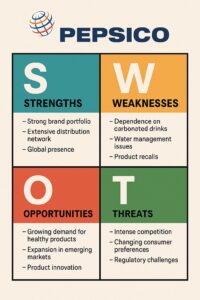
Strengths

Brand Recognition

One of PepsiCo’s most powerful assets is its strong brand recognition. Pepsi, Lay’s, Gatorade, Tropicana, Quaker Oats, and Doritos are just a few examples of brands that have become household names globally. This brand loyalty translates to consumer trust and repeat purchases.

For example, during the FIFA World Cup and the Olympics, PepsiCo’s strategic sponsorships help amplify brand visibility and consumer engagement worldwide. These events not only showcase Pepsi’s refreshing beverages but also associate the brand with excitement, sportsmanship, and global unity.

Diversified Portfolio

PepsiCo’s product portfolio is highly diversified, spanning beverages, salty snacks, cereals, and nutrition products. This diversification reduces dependency on any single product category and allows the company to cater to various consumer preferences. For instance, while soda sales have faced challenges, PepsiCo’s snack segment continues to grow robustly, balancing overall revenue streams.

This strategy has been crucial, especially as consumer tastes evolve. In recent years, PepsiCo has expanded its healthier product lines, such as baked snacks and low-calorie beverages, tapping into the health-conscious market segment.

Strong Financial Position

With a reported revenue of approximately $91.4 billion in 2023, PepsiCo maintains a strong financial position. Consistent revenue growth and profitability enable the company to reinvest in product innovation, marketing, and sustainability projects. For instance, PepsiCo’s investment in plant-based snack options and zero-sugar beverages reflects its ability to fund long-term initiatives that align with consumer trends.

Financial stability also allows the company to undertake strategic acquisitions, such as the purchase of Rockstar Energy and Poppi, broadening its product offerings and expanding market share.

Global Distribution Network

PepsiCo’s extensive global distribution network is a vital strength. The company ensures that its products are widely available—from urban supermarkets in New York to rural kiosks in India. This reach is supported by robust logistics, partnerships, and local manufacturing facilities, allowing PepsiCo to adapt products to regional tastes and preferences.

The company’s ability to navigate complex global supply chains was especially tested during the COVID-19 pandemic, where disruptions were quickly managed to keep shelves stocked worldwide.

Strategic Acquisitions

PepsiCo’s growth strategy includes strategic acquisitions that enhance its market presence and product variety. Notable examples are the acquisitions of Rockstar Energy, boosting PepsiCo’s footprint in the lucrative energy drink segment, and Poppi, a brand focused on gut-health beverages with prebiotics.

These acquisitions align with the shifting consumer demand toward functional and health-oriented drinks, illustrating PepsiCo’s forward-looking approach to market trends.

Weaknesses

Health Perception

Despite its diversified portfolio, PepsiCo faces significant health perception challenges. Many of its products, especially carbonated beverages and some snacks, are criticized for high sugar, salt, and fat content. This negative perception has led to increased scrutiny from health advocates, governments, and consumers.

For example, in countries like the UK and Mexico, sugary drink taxes and advertising restrictions have affected sales and forced companies like PepsiCo to rethink product formulations and marketing strategies.

Dependence on Carbonated Beverages

A large portion of PepsiCo’s revenue still depends on carbonated soft drinks (CSDs), particularly Pepsi-Cola. However, global consumption trends show a steady decline in soda sales due to growing health awareness and lifestyle changes.

This overreliance exposes the company to risks if these declining trends accelerate, as seen in North America and parts of Europe, where soda consumption per capita has dropped significantly over the past decade.

Environmental Impact

PepsiCo faces growing concerns related to its environmental impact, especially around plastic waste and water usage. As a major producer of packaged beverages and snacks, the company contributes to plastic pollution challenges worldwide.

While PepsiCo has committed to sustainability goals, including reducing virgin plastic usage and improving water efficiency, critics argue that the scale of the problem remains substantial. Environmental groups have repeatedly called on PepsiCo to accelerate its eco-friendly initiatives and enhance transparency in reporting.

High Debt Levels

PepsiCo carries significant long-term debt, which may limit its financial flexibility and increase interest expenses. High debt levels can constrain investment capacity, especially during economic downturns or periods of rising interest rates.

In 2024, rising global inflation and interest hikes increased debt servicing costs for many large corporations, including PepsiCo, adding pressure on profitability margins.

Opportunities

Health-Conscious Products

With consumers increasingly prioritizing wellness, PepsiCo has vast opportunities in health-conscious product development. The rise of plant-based snacks, low-sugar beverages, and functional foods opens new markets.

PepsiCo’s recent launch of products like LIFEWTR and its commitment to reducing added sugars across portfolios exemplify this direction. The growing trend toward gut health and immunity also provides fertile ground for innovation.

E-Commerce Expansion

The surge in online shopping, accelerated by the COVID-19 pandemic, offers PepsiCo new distribution channels through e-commerce platforms. Direct-to-consumer models and partnerships with online grocers enable the company to reach tech-savvy customers and improve data-driven marketing.

For instance, PepsiCo’s collaboration with Amazon and Walmart’s online portals allows for targeted promotions and subscription-based sales models, increasing consumer convenience and brand loyalty.

Sustainability Initiatives

Sustainability is no longer optional—it is a strategic imperative. PepsiCo’s investments in recycling technologies, sustainable packaging, and water conservation bolster its brand image and compliance with increasingly strict regulations.

In 2023, PepsiCo announced a significant reduction in plastic use by introducing biodegradable packaging in select markets. Such efforts not only address environmental concerns but also appeal to the growing segment of eco-conscious consumers.

Emerging Markets

Expanding presence in emerging markets like India, Africa, and Southeast Asia represents a major growth avenue. Rising incomes, urbanization, and changing lifestyles drive demand for convenient food and beverage products in these regions.

PepsiCo’s ability to tailor products to local tastes and price points has helped it gain ground in these markets. For example, the launch of region-specific flavors and affordable snack options has driven market penetration in India.

Threats

Intense Competition

PepsiCo faces intense competition from global giants such as Coca-Cola, Nestlé, and Unilever. These rivals continuously innovate and invest heavily in marketing, making it challenging to maintain market share.

For example, Coca-Cola’s aggressive push into the health and wellness segment with brands like Honest Tea and Costa Coffee has pressured PepsiCo to respond quickly and creatively.

Changing Consumer Preferences

Rapid shifts in consumer preferences toward healthier and natural products threaten PepsiCo’s traditional product lines. The growing popularity of fresh, organic, and minimally processed foods poses a challenge to mass-produced snacks and sodas.

Failure to adapt swiftly can result in lost market relevance and declining sales in developed markets where health trends are strongest.

Economic Factors

Global economic uncertainties, inflation, and potential downturns can reduce consumer spending power and affect PepsiCo’s profitability. Rising raw material costs and supply chain disruptions add to operational pressures.

In 2022-2023, inflationary pressures forced PepsiCo to increase product prices, risking consumer pushback and volume declines in price-sensitive markets.

Regulatory Challenges

Increasingly strict regulations around health standards, labeling, advertising, and environmental impact pose ongoing threats. Governments worldwide are imposing sugar taxes, banning certain additives, and requiring transparency on nutritional content.

PepsiCo must continuously adapt its compliance frameworks and product formulations to meet these evolving legal requirements, which can increase operational complexity and costs.

Strategic Recommendations

Product Reformulation

PepsiCo should prioritize developing and promoting healthier product alternatives, reducing sugar, salt, and artificial ingredients. Enhancing product transparency and nutritional value will build consumer trust and align with global health initiatives.

For example, reformulating classic products like Pepsi-Cola to offer low- or zero-sugar options, while expanding plant-based snack lines, will cater to the health-conscious consumer base.

Sustainability Focus

Intensifying efforts in recycling, biodegradable packaging, and water conservation will improve PepsiCo’s environmental footprint. Collaborating with governments and NGOs to create circular economy models can further enhance sustainability credentials.

Continued investment in sustainable agriculture practices will also secure long-term raw material supplies.

Market Diversification

Exploring new markets and demographics will mitigate risks from saturated or declining regions. PepsiCo can capitalize on emerging economies, younger consumers, and niche segments such as organic and functional foods.

Localized marketing campaigns and culturally relevant products will support successful market entry and growth.

Digital Transformation

Investing in technology to improve supply chain efficiency, data analytics, and customer engagement will enhance PepsiCo’s competitive edge. Embracing AI-driven demand forecasting and personalized marketing can optimize operations and boost sales.

Digital platforms also facilitate direct consumer relationships, enabling faster feedback loops and innovation cycles.

Competitors of PepsiCo

PepsiCo operates in a fiercely competitive industry, primarily the food and beverage sector, where several large multinational corporations vie for market share. Its main competitors are companies that challenge PepsiCo across various product categories—beverages, snacks, and nutrition. Below is a comprehensive analysis of PepsiCo’s key competitors:

The Coca-Cola Company

 Coca-Cola is PepsiCo’s most direct and well-known rival, especially in the carbonated soft drinks segment. The rivalry between Pepsi and Coca-Cola is one of the most famous in business history, often called the “Cola Wars.”

  • Coca-Cola’s flagship product, Coca-Cola soda, dominates many markets globally, especially in North America and Europe.
  • Coca-Cola owns a vast beverage portfolio, including Sprite, Fanta, Minute Maid, and Dasani water.
  • The company has been aggressively investing in healthier beverage options like Coca-Cola Zero Sugar and expanding into energy drinks with brands like Monster Energy.

Example:
In 2023, Coca-Cola launched a marketing campaign in the US called “Real Magic,” aimed at connecting emotionally with younger consumers, directly competing with PepsiCo’s branding efforts targeting the same demographic. This campaign helped Coca-Cola increase its market share in the US beverage sector by 2% in Q4 2023.

Nestlé S.A.

While Nestlé is primarily known as a food company, it is a strong competitor to PepsiCo in various product segments, especially bottled water, coffee, and snacks.

Competitive Edge:

  • Nestlé owns Nescafé, KitKat, Perrier, and Pure Life water, making it a major player in both food and beverage categories.
  • The company emphasizes health and nutrition, an area where PepsiCo is also investing heavily.
  • Nestlé’s presence in emerging markets is strong, providing tough competition for PepsiCo’s expanding footprint.

Example:
Nestlé’s acquisition of Blue Bottle Coffee in 2017 and its rapid expansion of premium coffee products has challenged PepsiCo’s coffee segment, particularly with PepsiCo’s Starbucks ready-to-drink coffee products, which it launched in partnership with Starbucks.

Unilever

Unilever competes mainly in the snacks and nutrition segments of PepsiCo’s business. Though better known for its personal care products, Unilever owns a substantial food and beverage portfolio.

Key Brands:

  • Ice cream brands like Magnum, Ben & Jerry’s, and Walls compete with PepsiCo’s snack-related frozen dessert products.
  • Unilever’s growing range of health-focused foods and snacks competes with PepsiCo’s efforts in healthier product lines.

 Example:
In 2022, Unilever acquired The Vegetarian Butcher, expanding its plant-based food options. This move directly competes with PepsiCo’s offering of healthier, plant-based snack alternatives, reflecting a growing consumer trend towards sustainability and health.

Kraft Heinz Company

Kraft Heinz is a major competitor in the packaged foods and snacks market. Although not as diverse in beverages as PepsiCo, Kraft Heinz competes heavily in snacks, sauces, and convenience foods.

Competitive Factors:

  • Brands like Kraft, Heinz, Planters, and Capri Sun are household names.
  • Kraft Heinz has a strong presence in North America and Europe, challenging PepsiCo in snack foods and complementary products.

Live Example:
In 2023, Kraft Heinz launched Planters’ Nut-rition Bars as a direct competitor to PepsiCo’s protein and nutrition bars, capturing a segment of the health-conscious snack market that PepsiCo is also targeting.

Mondelez International

Mondelez is a major global snack company, competing directly with PepsiCo’s Frito-Lay division.

Strengths:

  • Mondelez owns popular brands like Oreo, Cadbury, Toblerone, and Ritz, focusing heavily on biscuits, chocolates, and snacks.
  • The company has a strong foothold in emerging markets, similar to PepsiCo.

 Example:
Mondelez’s Oreo brand continues to be a top-selling biscuit worldwide, often competing with PepsiCo’s Lay’s and Cheetos for shelf space and consumer attention in snack aisles globally.

Red Bull GmbH

Red Bull is the dominant player in the energy drink market, directly competing with PepsiCo’s energy brands like Rockstar Energy.

Competitive Highlights:

  • Red Bull has a cult-like following and strong global brand recognition.
  • It leads the energy drink market with innovative marketing such as extreme sports sponsorships.

 Example:
Red Bull’s sponsorship of Formula 1 and extreme sports events continues to give it an edge in brand visibility, making it a formidable competitor to PepsiCo’s efforts to grow its Rockstar brand in the energy segment.

Conclusion

PepsiCo remains a formidable player in the global food and beverage sector, buoyed by strong brands, a diversified product lineup, and a vast distribution network. However, it faces challenges from health concerns, environmental pressures, and shifting consumer behaviors.

A well-executed SWOT analysis of PepsiCo reveals that capitalizing on its strengths while addressing weaknesses is crucial for seizing emerging opportunities and mitigating threats. By embracing innovation, sustainability, and digital transformation, PepsiCo is well-positioned to navigate the complex market landscape in 2026 and beyond.

Frequently Asked Questions (FAQs)

Q1: What is the primary strength of PepsiCo?
A1: PepsiCo’s primary strength lies in its strong global brand recognition and diversified product portfolio, which includes beverages, snacks, and nutrition products trusted worldwide.

Q2: Why is PepsiCo’s dependence on carbonated beverages a weakness?
A2: The global decline in soda consumption due to health concerns makes PepsiCo’s reliance on carbonated drinks a vulnerability, risking revenue drops if trends continue.

Q3: How is PepsiCo addressing environmental challenges?
A3: PepsiCo is investing in sustainable packaging, water conservation, and recycling programs to reduce its environmental impact and meet regulatory standards.

Q4: What opportunities does PepsiCo have in emerging markets?
A4: Growing urbanization, rising incomes, and changing consumer lifestyles in emerging markets provide PepsiCo opportunities to expand product offerings and increase market share.

Q5: How does intense competition affect PepsiCo?
A5: Competitors like Coca-Cola and Nestlé continuously innovate and invest in marketing, which pressures PepsiCo to stay agile and invest in product and marketing innovation.


SWOT Analysis of Amul

Comprehensive SWOT Analysis of Amul

Amul SWOT

Amul, an iconic Indian dairy brand, is not just a household name but a symbol of India’s White Revolution. With its origins dating back to 1946 in the town of Anand, Gujarat, Amul has transformed the Indian dairy industry by empowering millions of farmers and creating a sustainable supply chain that delivers quality dairy products to consumers across the country. It has successfully combined tradition with innovation, staying relevant to every generation of Indian consumers.

The significance of Amul in the Indian dairy industry is monumental. As the largest dairy cooperative in India, Amul sources milk from over 3.6 million farmers, offering them fair prices while ensuring consumers get affordable, high-quality dairy products. It is not just a company—it is a movement that redefined dairy farming and consumer trust in India.

Conducting a SWOT analysis of Amul is crucial to understanding the dynamics of its business model, its market positioning, the challenges it faces, and the potential areas of growth. This comprehensive study helps identify strategic areas for improvement while reinforcing what makes Amul an industry leader.

Amul at a Glance

 Brand Name: Amul
Established: 1946
Headquarters: Anand, Gujarat, India
Industry: Dairy & Food Processing
Parent Organization: Gujarat Cooperative Milk Marketing Federation (GCMMF)
Founders: Tribhuvandas Patel, Verghese Kurien
Milk Procurement: 3.6 million milk producers
Distribution Network: Over 10,000 distributors and 1 million retailers
Export Market: Over 40 countries including USA, UAE, Singapore, and Australia
Product Range: Milk, Butter, Cheese, Ice Cream, Chocolates, Paneer, Yogurt, Beverages
Advertising Icon: Amul Girl – Known for witty, topical ads

Strengths of Amul

Strong Brand Recognition

Amul has become synonymous with dairy in India. Its legacy, built over seven decades, is backed by consistent quality, affordability, and impactful advertising. The Amul Girl, an iconic mascot since 1966, has been a constant voice in India’s pop culture, making witty remarks on current events.

Example: During the COVID-19 lockdown, the Amul Girl was featured with a mask and the slogan “Maska Nahi, Mask Pehno”, urging people to stay safe. This simple campaign not only promoted health awareness but strengthened Amul’s emotional connect with its audience.

 Large Product Portfolio

Amul’s range covers everything from milk, butter, cheese, paneer, shrikhand, ice creams, and chocolates to newer segments like camel milk and lactose-free milk. It caters to various dietary needs and budgets, ensuring there’s something for every Indian.

Example: Amul Camel Milk, introduced for its health benefits, positioned the brand as an early mover in niche dairy segments.

 Wide Distribution Network

Amul boasts a supply network of over 10,000 distributors and 1 million+ retailers, ensuring daily delivery even to India’s remotest areas. Their well-managed cold chain logistics allow even sensitive products like milk and ice cream to retain freshness during transport.

Economies of Scale

Being India’s largest dairy cooperative, Amul benefits from economies of scale. Its massive production capabilities bring down costs per unit, allowing it to maintain quality while keeping prices affordable for consumers.

Efficient Supply Chain

Amul collects milk from over 3.6 million farmers across 18,700 villages daily. This highly organized procurement process ensures freshness, minimal wastage, and consistent farmer support.

 Farmer-Centric Cooperative Model

Amul’s core strength lies in its cooperative model. It is owned by farmers, run for their benefit, and managed by professionals. This ensures fair prices for producers and transparency throughout the supply chain.

Example: Farmers in Gujarat have seen consistent growth in income thanks to Amul’s direct procurement, skipping exploitative middlemen.

 Strong R&D and Innovation

Amul has been at the forefront of dairy innovation. Whether it’s probiotic curd, flavored milk, or camel milk, the brand constantly brings new offerings aligned with evolving consumer demands.

Example: Amul Lactose-Free Milk, targeted at lactose-intolerant consumers, gained instant popularity among urban health-conscious buyers.

Emotional Connect with Consumers

Generations of Indians have grown up with Amul. From school tiffins to tea-time snacks, Amul products hold a nostalgic place in people’s lives. This emotional bond drives loyalty beyond price or competition.

Export Potential

Amul exports its products to over 40 countries, including the USA, UAE, Singapore, and Australia. This highlights not just product demand but Amul’s capability to meet international quality and regulatory standards.

Affordable Pricing

Amul maintains competitive pricing despite offering premium quality. This value-for-money strategy has helped it penetrate markets across urban, semi-urban, and rural areas, appealing to all income groups.

 Weaknesses of Amul

Dependency on Indian Market

Amul relies heavily on domestic revenue. Its limited exposure to premium international markets makes it vulnerable to local economic and demand fluctuations.

 Limited Product Customization

Unlike global brands such as Nestlé, Amul offers fewer product variants tailored to specific regional or dietary preferences in international markets.

 Inconsistent Quality in Rural Areas

Due to decentralized procurement and regional packaging units, the taste and freshness of certain products may vary across regions, especially in far-flung rural locations.

Over-Diversification Risk

Venturing into non-core categories like cookies, fruit juices, and edible oils can stretch the brand’s focus. This move may dilute its image as a dairy expert.

Example: Amul’s Tru fruit juices, though innovative, haven’t matched the success of its dairy products.

 Limited Premium Branding

Amul excels at affordability but lags in offering luxury or gourmet products like artisanal cheeses or specialty butters, where brands like President or Mooz are gaining traction.

Supply Chain Bottlenecks in Remote Areas

Despite a robust logistics system, terrain and weather can disrupt deliveries in certain regions.

Example: In North-Eastern states, especially during the monsoon, product delays and stockouts are common due to poor road connectivity.

Opportunities for Amul

Rising Demand for Organic & Healthy Products

With the rise in health awareness, there’s growing demand for organic, low-fat, and probiotic dairy. Amul can tap this trend by expanding its health-focused offerings.

Urban Health Consciousness

Urban consumers are actively looking for protein-rich, calcium-fortified, and immunity-boosting food products. This opens the door for innovation in dairy-based beverages and nutritional snacks.

Expansion into Tier II & Tier III Cities

Smaller cities are seeing a boom in dairy consumption due to rising income and health awareness. These areas present untapped potential for Amul’s core and value-added products.

Growth in Packaged Food Sector

Busy lifestyles are driving demand for ready-to-eat and frozen meals. Amul can leverage its existing dairy range to launch convenient packaged food items.

Global Expansion

Amul’s global reach can grow, especially in regions with large Indian diaspora populations like Canada, UK, and Middle East, by offering ethnic dairy products familiar to expatriates.

Partnerships & Collaborations

Collaborating with retail giants like Walmart or fast-food chains like Subway can provide Amul greater market visibility and shared innovation opportunities.

Innovation in Dairy Alternatives

With the rise of veganism, Amul can expand into plant-based alternatives like almond, oat, and soy milk. The brand has already started exploring this space.

Strengthening E-Commerce Presence

Amul is already active on platforms like BigBasket and Amazon, but enhancing its direct-to-consumer channels and launching a dedicated mobile app could boost sales and brand engagement.

Example: During the pandemic, Amul launched home delivery services in major cities like Ahmedabad and Mumbai to maintain uninterrupted service.

Threats for Amul

Intense Competition

Amul is facing increasing competition from both domestic brands like Mother Dairy and Hatsun Agro, and global brands like Nestlé, Danone, and Britannia.

Changing Consumer Preferences

Shifts toward veganism, plant-based diets, and concerns over lactose intolerance are creating a growing customer base that prefers dairy-free options.

Milk Price Volatility

Raw milk prices fluctuate due to climate, fodder availability, and seasonal variation. This affects procurement costs and overall profitability.

Supply Chain Disruptions

Natural disasters, political unrest, and events like COVID-19 can severely impact milk collection, processing, and delivery schedules.

Government Regulations

Frequent changes in price caps, GST, FSSAI norms, and packaging guidelines affect production, marketing, and profitability.

Brand Dilution Risk

Amul’s ventures into too many product lines may blur its brand identity as a dairy leader.

Example: Introducing energy drinks or bakery products might confuse customers about Amul’s core strength in dairy.

Competitors of Amul Company 

 1. Mother Dairy – The North India Powerhouse

Mother Dairy is one of Amul’s closest rivals, especially in Northern India. Backed by the National Dairy Development Board (NDDB), it has a stronghold in urban markets like Delhi-NCR.

  • It’s best known for fresh milk, dahi (curd), lassi, and ice cream.
  • Their aggressive pricing and localized supply chain often attract daily consumers.

Example:
In Delhi NCR, Mother Dairy booths are as commonly found as kirana stores, often preferred for fresh milk due to daily availability and brand trust.

 2. Britannia – The FMCG Giant in Dairy

While Britannia is largely known for its biscuits, it has made significant strides in the dairy sector with products like cheese slices, flavored milk, butter, and dairy whitener.

  • Britannia focuses on premium packaging, innovation, and taste.
  • It’s especially competitive in urban areas and modern retail formats.

Example:
Britannia Cheese has become a staple in many urban homes due to its smooth texture and variety, competing head-on with Amul Cheese in metro cities.

 3. Nestlé – The International Challenger

Nestlé brings global experience and premium appeal into the Indian dairy space. Its products like Milkmaid (condensed milk), Nestlé a+ milk, flavored yogurts, and baby food offer international quality standards.

  • Nestlé positions itself in the premium segment, targeting health-conscious and brand-sensitive consumers.

Example:
In cities like Mumbai and Bangalore, Nestlé’s a+ Milk is often chosen for its UHT technology and packaging, even though it’s priced higher than Amul.

 4. Hatsun Agro – Southern India’s Dairy King

Headquartered in Tamil Nadu, Hatsun Agro dominates the South Indian dairy market under brands like Arokya, Arun Ice Creams, and Hatsun Curd.

  • Its distribution is robust in rural and semi-urban South India, offering regional flavors and products.
  • Known for its high-quality flavored milk, curd, and ghee.

Example:
In Tamil Nadu, Arokya Milk by Hatsun Agro is preferred over Amul due to its freshness and deep-rooted regional branding.

5. Parag Milk Foods (Gowardhan, Go Cheese)

Parag Milk Foods is rapidly gaining ground in the value-added dairy product segment.

  • It is especially known for its Gowardhan Ghee, Go Cheese, and Paneer.
  • The brand focuses on rural penetration and digital marketing to connect with millennials.

Example:
Go Cheese, endorsed by celebrities like Sonu Sood, has become a hit among young consumers, competing closely with Amul’s cheese cubes and spreads.

  1. Rise of Plant-Based Milk Brands – A Modern Threat

The shift in consumer behavior toward plant-based diets has opened doors for new players like:

  • So Good – Almond and soy milk products
  • Alpro – European plant-based brand with high-end appeal
  • Epigamia – Greek yogurt, almond milk, and vegan dairy alternatives

These brands target urban, health-conscious, and lactose-intolerant consumers, offering dairy-free substitutes.

Example:
In tier-1 cities like Bangalore, vegan cafes and fitness-conscious consumers prefer Epigamia Almond Milk over regular dairy, especially during health detox challenges.

Conclusion

Amul is a shining example of a successful cooperative model that integrates farmers, technology, and business acumen. Its strengths lie in its vast distribution network, affordable pricing, diverse product range, and farmer empowerment. However, challenges like competition, over-diversification, and changing consumer preferences need to be strategically managed.

To maintain its leadership:

  • Amul should focus on premiumization of products.
  • Expand global and online presence.
  • Innovate in dairy alternatives.
  • Enhance quality consistency.
  • Leverage health and nutrition trends.

The future lies in innovation, strategic expansion, and staying true to its core identity while adapting to market changes.

FAQs 

  1. What is the full form of Amul? Amul stands for Anand Milk Union Limited.
  2. Who is the founder of Amul? Dr. Verghese Kurien is considered the architect behind Amul and the White Revolution.
  3. What are the main products of Amul? Milk, butter, cheese, paneer, curd, ice cream, chocolates, and ghee are some of the main products.
  4. What makes Amul different from other dairy brands? Its cooperative model and direct farmer engagement make it unique.
  5. Is Amul present internationally? Yes, Amul exports to over 40 countries including the USA, UAE, and Australia.
  6. What are the disadvantages of Amul milk? Some rural areas report inconsistent quality due to local packaging and distribution issues.
  7. What is Amul’s biggest strength? Its extensive supply chain and emotional brand connection with Indian consumers.
  8. What are the key competitors of Amul? Nestlé, Mother Dairy, Britannia, Hatsun Agro, and Parag Milk Foods.
  9. Is Amul investing in dairy alternatives? Yes, Amul has started launching products like lactose-free milk and almond milk.
  10. How has Amul impacted Indian farmers? By eliminating middlemen, Amul ensures better returns for over 3.6 million farmers.


SWOT Analysis of Apple

A Comprehensive SWOT Analysis of Apple 

Apple SWOT

Apple Inc. is a global technology leader, renowned for its innovation, design excellence, and premium products. Founded in 1976 by Steve Jobs, Steve Wozniak, and Ronald Wayne, Apple has grown into one of the world’s most valuable companies. Its journey from a garage startup to a trillion-dollar enterprise is a testament to its strategic brilliance and relentless focus on user experience.

In today’s rapidly evolving tech landscape, companies need to constantly reassess their strategic position. One of the most effective tools for this is a SWOT analysis — which stands for Strengths, Weaknesses, Opportunities, and Threats. This analytical framework helps in identifying internal and external factors that can impact a company’s success.

This blog offers a deep dive into the SWOT analysis of Apple, examining the elements that contribute to its ongoing dominance, as well as the challenges it must navigate. Through this comprehensive lens, we aim to understand the pillars of Apple’s strategy and how it continues to lead in innovation and user satisfaction.

Strengths of Apple

1. Global Brand Recognition and Loyalty

Apple is one of the most recognized and admired brands globally. Its sleek designs, minimalist branding, and consistent messaging have helped cultivate a powerful emotional connection with consumers. According to Interbrand’s 2023 report, Apple retained its position as the world’s most valuable brand, valued at over $500 billion.

Real-world example: Apple’s product launches are global events. The anticipation around new iPhone releases demonstrates the loyalty and enthusiasm of its user base.

2. Innovative Product Ecosystem

Apple’s product ecosystem is one of its biggest strengths. Devices like the iPhone, iPad, Mac, Apple Watch, and AirPods are seamlessly interconnected through iCloud and macOS/iOS integrations. This ecosystem ensures customer retention and cross-selling opportunities.

Live example: A user with an iPhone is more likely to buy a Mac or Apple Watch due to ecosystem advantages like AirDrop, Handoff, and Continuity Camera.

3. Strong Financial Performance

Apple consistently delivers robust financial results. With revenue exceeding $380 billion in FY 2023 and profit margins higher than most competitors, its financial muscle supports innovation, R&D, and strategic acquisitions.

Live example: In Q4 2023, Apple reported $90.1 billion in revenue, with services contributing $22.3 billion, marking its best-ever performance in that segment.

4. High-Margin Products and Premium Pricing Strategy

Apple’s focus on premium quality allows it to price its products higher than competitors. Despite high prices, strong brand loyalty ensures consistent demand.

Example: The iPhone 14 Pro Max starts at a significantly higher price than many Android phones, yet consistently tops sales charts in multiple countries.

5. Strong R&D and Technological Leadership

Apple invests heavily in research and development, spending over $29 billion in 2023 alone. This focus has led to groundbreaking features like Face ID, M1 chips, and the Vision Pro mixed reality headset.

Example: Apple’s in-house M1, M2, and now M3 chips have significantly improved Mac performance and battery life, marking a major shift from Intel dependency.

Weaknesses of Apple

1. High Product Pricing Limits Market Penetration

While premium pricing drives profits, it also restricts Apple’s reach in developing economies where consumers may prioritize affordability.

Example: In countries like India and Brazil, iPhones are often priced out of reach for average consumers, limiting market share compared to Android alternatives.

2. Dependence on a Limited Product Line

A significant portion of Apple’s revenue comes from the iPhone. While services and wearables are growing, over-reliance on one product category poses risks.

Example: iPhone accounted for more than 50% of Apple’s revenue in 2023. Any slump in iPhone sales directly impacts the company’s overall performance.

3. Closed Ecosystem Limits Flexibility

Apple’s ecosystem is tightly controlled, which can limit user customization and flexibility compared to open-source platforms like Android.

User complaint: Many users feel restricted by Apple’s “walled garden” approach, which limits third-party integrations and file transfer options.

4. Slower Innovation in Some Product Categories

While Apple leads in smartphone and chip innovation, categories like Mac and iPad often receive incremental updates.

Example: MacBook designs saw minimal changes between 2016-2020, leading to criticism about a lack of innovation.

Opportunities for Apple

1. Expansion into Emerging Markets

As smartphone penetration grows in countries like India, Africa, and Southeast Asia, Apple has the opportunity to tap into new customer bases.

Live example: Apple opened its first retail store in Mumbai, India, in 2023, signaling its strategic push into the Indian market.

2. Growth in Services

Apple’s services segment, including iCloud, Apple Music, Apple TV+, and the App Store, continues to grow, offering recurring revenue streams.

Real-world data: Services revenue reached an all-time high of $22.3 billion in Q4 2023, demonstrating immense growth potential.

3. Development in AR/VR and AI Integration

Apple’s investment in emerging technologies like augmented reality and artificial intelligence is setting the stage for its next big leap.

Example: The Vision Pro headset is Apple’s ambitious entry into the mixed reality space, combining advanced hardware and software capabilities.

4. Healthcare and Wearables Innovation

With the Apple Watch and HealthKit, Apple is becoming a key player in digital health and wellness.

Example: Apple Watch Series 8 features temperature sensing and crash detection, reinforcing its commitment to health and safety.

Threats Facing Apple

1. Intense Competition

Apple faces fierce competition from Samsung, Google, Huawei, and other tech giants across multiple product categories.

Example: Samsung consistently challenges Apple in global smartphone shipments, while Google innovates with its Pixel line and AI integration.

2. Global Economic Fluctuations

Economic downturns, inflation, and changes in consumer spending can impact demand for high-priced Apple products.

Example: During the COVID-19 pandemic, Apple experienced temporary supply and demand disruptions, although it recovered faster than many competitors.

3. Regulatory Pressures

Governments worldwide are scrutinizing Apple over antitrust practices, data privacy, and app store monopolies.

Live example: The European Union’s Digital Markets Act requires Apple to allow third-party app stores on its devices, which could impact App Store revenue.

4. Supply Chain Vulnerabilities

Apple’s reliance on suppliers and manufacturers, especially in China, makes it vulnerable to geopolitical tensions and logistic disruptions.

Example: The U.S.-China trade war and COVID-related factory shutdowns in 2020 significantly affected Apple’s supply chain.

6. Main Competitors of Apple


Apple may be a tech titan, but it doesn’t dominate the field alone. Several global brands challenge Apple across various segments—from smartphones to cloud services. Here’s a closer, humanized look at Apple’s top competitors and how they are making their mark:

1. Samsung 

Samsung is perhaps Apple’s biggest rival in the smartphone market. With its Galaxy lineup, Samsung consistently pushes innovation in hardware, displays, and features.

  • Example: Samsung Galaxy S24 Ultra directly competes with the iPhone 15 Pro Max, boasting advanced zoom cameras, stylus support, and ultra-fast refresh rates.
  • Samsung is also a leading supplier of OLED displays, even to Apple!

 Strengths: Variety, innovation in foldable phones, strong presence in Asia and Europe.

2. Google 

Google battles Apple on several fronts. Android is the dominant mobile OS, and Pixel phones showcase Google’s hardware capabilities.

  • Example: Google Pixel 8 Pro competes with the iPhone 15 by emphasizing AI-driven photography and real-time language translation.
  • Google’s Cloud Platform is also a strong competitor to Apple’s iCloud and enterprise services.

 Strengths: AI & software ecosystem, real-time services, search engine dominance.

 3. Microsoft 

Microsoft and Apple go head-to-head in computing and productivity software. Microsoft’s Surface devices compete directly with Apple’s MacBooks and iPads.

  • Example: Surface Laptop Studio 2 vs. MacBook Pro – both are designed for professionals and creatives with high processing needs.
  • Microsoft 365 is a powerful alternative to Apple’s iWork suite and integrated business tools.

 Strengths: Enterprise software, cloud leadership with Azure, hybrid devices.

4. Huawei & Xiaomi 

These companies are disrupting Apple’s premium pricing model with feature-rich smartphones at lower costs.

  • Example: Xiaomi 14 Pro offers flagship specs similar to the iPhone 15 but at nearly half the price.
  • Huawei P60 Pro impresses with its camera tech and custom HarmonyOS, avoiding reliance on Google or Apple ecosystems.

Strengths: Competitive pricing, high-end specs, rapid rollout of new technologies.

 5. Amazon 

While Amazon isn’t a smartphone brand, it competes strongly in cloud and smart home ecosystems.

  • Example: Amazon Alexa and Echo devices rival Apple’s Siri and HomePod for smart assistant dominance.
  • Amazon Web Services (AWS) is the global leader in cloud computing, competing with Apple’s backend and developer services.

 Strengths: Smart home dominance, extensive cloud infrastructure, integration with e-commerce.


7. Conclusion

The SWOT analysis for Apple reveals that the company enjoys several strategic advantages, including brand power, a loyal customer base, and technological leadership. These strengths, coupled with strong financials and an expanding ecosystem, position Apple to thrive in the face of evolving market dynamics.

However, Apple must navigate challenges like market saturation, regulatory scrutiny, and supply chain risks. By leveraging its R&D prowess and expanding into new markets and service segments, Apple can mitigate threats and capitalize on growth opportunities.

Ultimately, Apple’s commitment to innovation, privacy, and seamless user experience continues to set it apart in an increasingly competitive tech landscape.

FAQs

Q1:What is the SWOT analysis of Apple? The SWOT analysis of Apple identifies its internal strengths and weaknesses and external opportunities and threats. It highlights Apple’s strong brand, innovation, and premium ecosystem while also addressing challenges like high pricing and supply chain risks

Q2:Why is Apple considered a market leader? Apple is considered a market leader due to its innovation, brand loyalty, financial strength, and ability to deliver seamless user experiences across its product ecosystem.

Q3:What are Apple’s major threats?Apple faces threats such as intense competition, regulatory scrutiny, economic fluctuations, and supply chain vulnerabilities.

Q4:How does Apple plan to grow in the future? Apple plans to grow by expanding into emerging markets, enhancing its services, investing in AR/VR and AI, and innovating in health and wearable technology.

Q5:What makes Apple’s ecosystem unique? Apple’s ecosystem is unique due to its seamless integration across devices, consistent user experience, and exclusive software features that encourage brand loyalty..

Q6: What are Apple’s key strengths? Apple’s main strengths include strong brand loyalty, an integrated product ecosystem, high financial performance, and leadership in innovation.

Q7: What are the main weaknesses of Apple? High product prices, dependence on the iPhone, a closed ecosystem, and occasional slow innovation in certain product lines are key weaknesses.

Q8: What opportunities lie ahead for Apple? Emerging markets, services growth, AR/VR and AI developments, and healthcare innovation are major growth avenues for Apple.

Q6: How does Apple compete in the market? Apple differentiates through premium pricing, product quality, ecosystem integration, and a focus on privacy and customer experience.

Q7: What is Apple’s strategy for future growth? Apple aims to grow by expanding into new markets, enhancing its services segment, investing in next-gen technologies, and strengthening its health and wearable product lines.


SWOT Analysis of TCS

SWOT Analysis of TCS

Tata Consultancy Services (TCS) stands as a global IT services giant, known for its unparalleled expertise in technology and consulting. As one of the largest IT service providers worldwide, TCS has become a cornerstone of digital transformation for businesses across the globe.

Conducting a SWOT analysis for TCS not only highlights its current market standing but also offers critical insights into its long-term growth prospects and strategic direction.

Understanding its strengths, weaknesses, opportunities, and threats is vital for crafting effective business strategies and staying ahead in the competitive IT landscape.

Purpose of the SWOT Analysis

The primary purpose of a SWOT analysis is to assess a company’s internal strengths and weaknesses while identifying external opportunities and threats. This comprehensive evaluation provides a holistic view of a company’s position in the market, guiding strategic planning and decision-making processes.

For TCS, this analysis is particularly crucial as it navigates the rapidly evolving technology sector and strives to maintain its leadership in digital solutions, consulting, and IT services.

 Company Overview

Founded in 1968 as a division of Tata Sons, Tata Consultancy Services has evolved into a global powerhouse in the IT industry. Headquartered in Mumbai, India, TCS operates in over 50 countries with a workforce exceeding 600,000 employees as of 2024. It has achieved remarkable financial success, generating approximately $30 billion in annual revenue for FY 2023. With a robust global presence and a diverse portfolio of services, TCS continues to set benchmarks in the IT sector, making it a preferred partner for digital transformation across industries.

Key Facts about TCS

Founded 1968
Headquarters Mumbai, India
Global Presence Operations in over 50 countries
Employee Strength Over 600,000 (2024)
Annual Revenue Approximately $30 billion (FY 2023)
Brand Value $19.2 billion (2024)
Industry Information Technology & Consulting
Founder J. R. D. Tata, F. C. Kohli
Net Profit $5.219 billion (2023)

Strengths of TCS

 Extensive Global Reach: 

TCS operates across five continents, making it one of the most geographically diversified IT service providers. This global footprint reduces its dependence on any single market and provides resilience against regional economic downturns. 

For example, TCS’s partnership with the UK’s National Employment Savings Trust (NEST) highlights its ability to manage large-scale, complex projects globally.

 Strong Brand Reputation: TCS is consistently ranked among the top IT service providers globally, with a brand value of $19.2 billion in 2024. This strong brand equity reinforces its credibility and customer trust, making it a preferred partner for digital transformation. For instance, TCS has been recognized by Gartner as a leader in the ‘Magic Quadrant for IT Services’, reflecting its market influence.

 Diverse Service Portfolio: 

TCS offers a wide range of services, including IT consulting, digital transformation, business process outsourcing (BPO), cloud computing, and cybersecurity. This comprehensive service lineup ensures its relevance across various industries. 

For example, TCS’s partnership with Jaguar Land Rover supports their digital transformation journey, integrating AI and IoT to enhance customer experiences.

Robust Financial Performance:

 TCS has a history of consistent revenue growth, high profit margins, and strong cash reserves, allowing it to invest in cutting-edge technologies. This financial strength acts as a cushion against market uncertainties. 

For instance, TCS reported a revenue of $27.9 billion in FY 2023-24, reflecting its strong market position.

 Strategic Partnerships: 

TCS collaborates with industry leaders like Amazon Web Services (AWS), Adobe, and Dell, enhancing its ability to deliver integrated digital solutions.

 For example, its partnership with AWS has accelerated cloud adoption for clients globally, providing scalable and cost-effective solutions.

Weaknesses of TCS

 Dependence on Key Markets: 

Despite its global presence, a significant portion of TCS’s revenue comes from the U.S. market, making it vulnerable to economic slowdowns and policy changes in this region.

For example, the U.S. accounted for over 50% of TCS’s total revenue in 2023, highlighting this dependency.

 Talent Retention Challenges: 

Managing and retaining skilled professionals remains a significant challenge in the highly competitive IT industry. 

For instance, TCS reported an annual attrition rate of around 20% in 2023, impacting project continuity and increasing recruitment costs.

 Limited Presence in Emerging Technologies: 

While TCS is a leader in traditional IT services, it needs to strengthen its capabilities in emerging areas like blockchain, advanced analytics, and cybersecurity to maintain its competitive edge. 

For example, competitors like Accenture and IBM have made significant strides in these areas, outpacing TCS in specialized solutions.

Opportunities for TCS

 Digital Transformation Demand: 

With businesses increasingly adopting digital-first strategies, TCS stands to benefit from this global shift. 

For example, the global digital transformation market is projected to reach $1.8 trillion by 2025, presenting vast opportunities for companies like TCS.

 Emerging Markets: 

Developing regions, particularly in Asia and Africa, present significant growth potential as they invest in IT infrastructure and digital solutions. 

For instance, TCS has expanded its presence in markets like India and South Africa, capitalizing on the digital growth wave.

 Innovation in AI and Automation: 

The rise of artificial intelligence and automation offers TCS the chance to enhance its service offerings and improve operational efficiency.

 For example, TCS’s ‘Ignio’ platform uses AI to automate IT operations, reducing costs and improving service quality.

 Sustainability Initiatives: 

As businesses increasingly prioritize sustainability, TCS can leverage its expertise in green IT solutions. 

For instance, TCS’s partnership with the UK government for the ‘Green Britain’ initiative demonstrates its commitment to sustainable digital solutions.

Threats to TCS

Intense Competition: 

TCS faces stiff competition from global IT giants like Accenture, Infosys, Wipro, Cognizant, and HCL Technologies, all vying for the same enterprise clients.

 For example, Accenture’s aggressive investment in AI and cloud services presents a direct challenge to TCS’s market share.

 Regulatory Challenges: 

Operating in multiple countries exposes TCS to complex and ever-changing regulatory requirements, adding to operational risks.

 For instance, the evolving data privacy regulations in the European Union (GDPR) present significant compliance challenges.

 Technological Disruptions: 

Rapid advancements in technologies like AI, quantum computing, and blockchain can quickly render existing solutions obsolete, requiring constant innovation.

 For example, the rapid rise of OpenAI’s ChatGPT has disrupted traditional customer service models, pushing IT firms to adapt.

Economic Uncertainties:

 Global economic slowdowns, inflation, and changing geopolitical landscapes can impact client budgets and reduce IT spending. 

For example, the global economic slowdown in 2023 led to reduced IT budgets across sectors, impacting service demand.

Key Competitors of TCS:

  • Accenture: 

Known for its strong consulting and digital transformation capabilities. For instance, Accenture helped BMW enhance its digital sales and customer experience, significantly boosting customer satisfaction.


  • Infosys:

 A major player in IT services with a focus on digital, cloud, and automation. Infosys collaborated with Rolls-Royce to develop AI-based digital solutions for real-time data analysis and predictive maintenance.


  • Wipro: 

Offers a wide range of IT, consulting, and business process services. For example, Wipro partnered with Microsoft to accelerate digital innovation for enterprise clients through the Wipro FullStride Cloud Services.


  • Cognizant: 

Focuses on digital transformation, cloud services, and AI-driven solutions. Cognizant supported Vodafone in launching a secure, cloud-based IoT platform, enhancing their connectivity services.


  • HCL Technologies: 

Specializes in IT services and product engineering, with a strong focus on digital innovation. For instance, HCL helped Boeing develop mission-critical aerospace software, leveraging cutting-edge engineering and digital capabilities.


FAQs about TCS and its SWOT Analysis

What is the full form of TCS?
TCS stands for Tata Consultancy Services, a leading global IT services, consulting, and business solutions organization, headquartered in Mumbai, India. It is part of the Tata Group, one of India’s largest and oldest multinational conglomerates.

How does TCS maintain its leadership in the IT industry?
TCS maintains its leadership through a combination of innovation, customer-centric solutions, and operational excellence. It consistently invests in cutting-edge technologies like artificial intelligence, machine learning, cloud computing, and cybersecurity. For example, TCS’s Ignio™, an award-winning cognitive automation platform, helps clients optimize IT operations. TCS also focuses on a strong culture of continuous learning and upskilling, ensuring its workforce is always ahead in technology trends.

What are the major strengths of TCS?

Global Presence: Operates in over 50 countries.

Strong Brand Value: Part of the Tata Group, known for trust and reliability.

Diverse Service Portfolio: Includes consulting, IT services, engineering, and digital solutions.

Skilled Workforce: Over 600,000 employees globally, with a focus on continuous learning.

Digital Transformation Leadership: Trusted by major brands like Jaguar Land Rover for digital innovation.

How does TCS address the challenges of talent retention?
TCS focuses on creating a positive work environment, offering competitive compensation, and providing ample growth opportunities. It has programs like TCS Elevate and TCS Xplore that encourage professional development and career advancement. Additionally, TCS invests in employee wellness, work-life balance, and flexible work arrangements, which significantly improve retention rates.

What makes TCS a preferred IT service provider globally?
TCS is preferred for its reliability, scalability, and comprehensive service portfolio. It builds long-term relationships with clients, like American Express and Nestlé, by providing customized solutions, robust security, and seamless integration with emerging technologies.

How does TCS handle competition from companies like Accenture and Infosys?
TCS maintains a competitive edge through continuous innovation, cost leadership, and customer-centric approaches. It differentiates itself by focusing on deep industry expertise, strong client relationships, and investments in next-gen technologies. For instance, TCS’s BFSI (Banking, Financial Services, and Insurance) segment is a key area where it outperforms competitors like Accenture through specialized solutions and global delivery capabilities.

What is the SWOT analysis of TCS?

Strengths: Global brand, strong financials, extensive talent pool, diverse service offerings.

Weaknesses: High employee attrition, dependency on major markets like the US and Europe.

Opportunities: Digital transformation, cloud adoption, AI, and IoT.

Threats: Intense competition, economic slowdown, and cybersecurity risks.

Conclusion

TCS stands as a global IT leader with a strong brand reputation, extensive global reach, and robust financial performance. However, it must address challenges like market dependence, talent retention, and emerging technology gaps to maintain its competitive edge.

By leveraging growth opportunities in digital transformation, AI, and sustainability, TCS can strengthen its market position and continue its journey as a global technology leader. Understanding the strengths, weaknesses, opportunities, and threats facing TCS is essential for crafting effective business strategies and ensuring long-term success.


SWOT Analysis of Reliance Industries

Reliance Industries Limited (RIL) has stood as a towering pillar in India’s corporate landscape for decades. With its roots in textiles and a meteoric rise across petrochemicals, refining, telecommunications, and retail, Reliance represents not just a business success story, but a phenomenon that reshaped India’s industrial and economic journey. In this blog, we present a detailed SWOT Analysis of Reliance Industries to uncover the internal and external factors driving its strategy and future.

Overview of Reliance Industries Limited (RIL)

Founded in 1966 by visionary entrepreneur Dhirubhai Ambani, Reliance Industries has grown from a small textile manufacturer into a global conglomerate with operations spanning petrochemicals, oil refining, oil & gas exploration, telecommunications (Jio), and retail.

With revenues surpassing INR 9.76 lakh crore in FY 2023, Reliance employs over 2.5 lakh people globally. Its customer base runs into hundreds of millions, especially through Reliance Jio and Reliance Retail, both of which are now leaders in their respective sectors.

Live Example: When Reliance Jio entered the telecom market in 2016, it disrupted the entire industry with free data and calls, forcing giants like Airtel and Vodafone to rethink their pricing models. Jio’s strategy brought a digital revolution across India, connecting rural and urban users alike.

Company Profile

Founder Dhirubhai Ambani
Year Founded 1966
Headquarters Mumbai, Maharashtra, India
No. of Employees 230,000+
Chairman & MD Mukesh Ambani
Company Type Public
Market Cap(2023) Approx. USD 220+ Billion
Annual Revenue $100 Billion (FY 2023)
Net Profit $8 Billion (FY 2023)


  • Headquarters: Mumbai, Maharashtra, India
  • Chairman & MD: Mukesh Ambani
  • Market Cap (2023): Approx. USD 220+ Billion
  • Sectors: Energy, Petrochemicals, Retail, Digital Services, Green Energy

Key Milestones:

  • 2002: Launch of Reliance Infocomm
  • 2016: Disruption with Jio 4G services
  • 2020: Raised $20B+ for Jio Platforms from global investors like Facebook, Google
  • 2021 onwards: Focus on green hydrogen and solar energy, announcing Reliance New Energy Solar Ltd

Real Incident: In 2020, at the peak of the COVID-19 pandemic, while businesses struggled, Reliance raised billions from investors like Silver Lake, KKR, and Facebook, showing unmatched investor confidence in its digital vision.

SWOT Analysis of Reliance Industries

Swot Analysis of reliance

In this section, we present the comprehensive SWOT Analysis of Reliance Industries. This strategic breakdown helps understand where the company excels, where it struggles, what growth paths it can pursue, and what external threats could hinder its trajectory.

Strengths of Reliance Industries

Diversified Business Portfolio

One of Reliance’s strongest pillars is its highly diversified portfolio. The company is active in a range of sectors—oil refining, petrochemicals, telecommunications, digital platforms, retail, and green energy. This diversification acts as a safety net. If one segment underperforms, others can compensate, helping to stabilize overall revenue.

Live Example: During the 2020 global oil price crash, RIL’s refining margins shrank. However, Reliance Jio and Reliance Retail reported strong growth during the same period, thanks to increased digital consumption and essential goods demand during lockdowns. This balance between traditional and modern sectors ensured RIL remained resilient.

Technological Innovation – Reliance Jio

Reliance’s leap into telecom through Jio transformed India’s digital economy. With a 4G-only network at launch and aggressive pricing, Jio democratized internet access. It later expanded into fiber broadband (JioFiber), cloud computing, and is now pioneering 5G and AI-based network management systems.

Live Example: In 2023, Jio rolled out 5G trials in metros like Mumbai and Delhi, using AI algorithms to optimize bandwidth and user experience. This placed Jio at the forefront of next-gen connectivity in India.

Dominant Market Position in Energy & Telecom

RIL owns the world’s largest refining complex in Jamnagar, Gujarat, and dominates India’s petrochemical supply. Simultaneously, Jio commands the largest telecom subscriber base in India, with over 450 million users as of early 2024.

This twin dominance in traditional and digital infrastructure makes Reliance unmatched in its market leverage and reach.

Strong Financial Performance

Reliance’s financials reflect robust management and high capital efficiency. In FY2022–23, the company posted a net profit of ₹74,088 crore, driven by telecom and retail performance. Its debt-to-equity ratio has improved in recent years, thanks to deleveraging strategies and stake sales to global investors.

These figures reassure shareholders of the company’s financial health and capacity for further expansion.

Brand Equity and Infrastructure Capabilities

Over the decades, Reliance has built a reputation for trust, scale, and delivery. From mega refinery infrastructure and retail supply chains to data centers and last-mile fiber connectivity, its infrastructure capabilities are unparalleled in India.

Whether it’s JioMart delivering groceries or JioCinema streaming IPL matches, Reliance has become part of everyday Indian life.

Weaknesses of Reliance Industries

Overdependence on Petrochemicals & Oil

Despite branching into new sectors, a substantial portion of RIL’s profits still stem from oil and petrochemical businesses. This exposes it to global price volatility and demand-supply shocks.

Example: The 2020 oil market crash, triggered by the pandemic and price wars between OPEC nations, caused RIL’s refining margins to fall, denting overall profitability despite gains in digital and retail.

High Debt Burden

To finance massive ventures like Jio, JioFiber, and now green energy, Reliance has taken on significant debt over the past decade. While it announced it became net-debt-free in 2020 through stake sales, future projects like green hydrogen plants and solar manufacturing may again increase liabilities.

Live Example: Acquisitions like Future Retail, Hamleys, Netmeds, and investment in multiple tech startups have required huge capital inflows, increasing financial pressure.

Complex Conglomerate Structure

Reliance’s presence in so many unrelated sectors leads to operational complexity. Managing diverse business units with unique regulatory, technological, and logistical demands can dilute executive focus and slow decision-making.

Regulatory and Compliance Risks

Operating in sectors like telecom, retail, and energy means Reliance is constantly under the lens of regulatory bodies. It has faced scrutiny from the Competition Commission of India (CCI), TRAI, and even the Enforcement Directorate, depending on the sector.

For instance, telecom rivals have raised concerns over Jio’s pricing practices and spectrum acquisitions.

Declining Production in Oil & Gas Exploration

While Reliance has invested heavily in exploration blocks, output hasn’t always met expectations. The once-celebrated KG-D6 basin, which was expected to transform India’s natural gas landscape, has seen dwindling production.

This raises questions about the sustainability and returns from its upstream energy investments.

Opportunities for Reliance Industries

Jio Ecosystem Expansion

Reliance is building a digital super-app ecosystem with Jio at its core—combining telecom, payments, OTT content, retail, health, education, and more.

Live Example: In 2023, JioCinema secured exclusive streaming rights for IPL, clocking billions of views. This move not only disrupted traditional broadcasters like Star Sports but also increased ad revenue potential and brand stickiness for Jio platforms.

Green Energy and Sustainability Push

Reliance aims to invest $10 billion over the next three years in solar panel manufacturing, green hydrogen, battery storage, and fuel cells. Its subsidiary, Reliance New Energy Ltd, is spearheading this transition.

Real Example: The acquisition of REC Solar Holdings (Norway) and partnerships with Stiesdal and Ambri signal Reliance’s global ambition in renewables. These moves align with India’s clean energy goals and could make Reliance a leader in the future energy economy.

Global Market Expansion

Reliance is eyeing emerging markets in Africa and Southeast Asia, particularly for Jio and retail services. These regions, with rising internet adoption and underpenetrated retail infrastructure, offer tremendous growth potential.

Cross-Sector Synergy

The interplay between telecom, retail, and digital services offers unique bundling possibilities. For instance, customers using Jio SIMs can get loyalty points or cashback when they shop on JioMart or subscribe to JioCinema Premium.

Example: JioFiber bundles now include OTT apps like Disney+ Hotstar, JioCinema, and JioSaavn, creating an integrated digital experience.

Strategic Acquisitions and Tech Investments

Reliance’s investment arm has acquired or partnered with multiple startups in AI (Haptik), health-tech (Netmeds), local search (JustDial), and fashion-tech (Fynd). These moves build a deeper digital moat and drive innovation internally.

Threats to Reliance Industries

Intensifying Competition

Reliance’s success has triggered strong reactions from incumbents and rivals:

  • Airtel is pushing ahead with 5G and premium postpaid offerings
  • Amazon and Flipkart dominate e-commerce and logistics
  • Adani Group is entering data centers, green energy, and telecom
  • Tata Group has consolidated its digital efforts under Tata Neu and is revamping its retail empire

Live Example: Tata Neu’s bundling of BigBasket, Croma, and Tata Play with loyalty points mirrors Reliance’s ecosystem strategy—posing a serious threat in the consumer tech space.

Cybersecurity and Data Privacy Risks

With Reliance now managing telecom data, OTT subscriptions, payment gateways, and health data, it is a high-value target for cyberattacks.

Real Example: In 2022, a reported vulnerability in Jio’s call data records (CDR) system raised serious concerns about data protection, though no major breach occurred. Such events could damage user trust and lead to regulatory penalties.

Regulatory Changes

Policy shifts in foreign direct investment (FDI) in retail, telecom licensing, or carbon taxation can significantly affect Reliance’s strategies.

For instance, India’s tightening of FDI rules in multi-brand retail has complicated Reliance’s offline expansion plans with brands like 7-Eleven.

Global Oil and Geopolitical Volatility

Crude oil prices are susceptible to global conflict, production quotas, and sanctions. For example, the Russia-Ukraine war caused Brent crude to spike to $120/barrel, increasing input costs and squeezing refining margins for Reliance.

Rapid Technological Shifts

Emerging technologies like AI, blockchain, Web3, and quantum computing are disrupting industries. If RIL doesn’t adapt fast enough, especially in sectors like telecom, retail tech, or green energy, it risks being outpaced.

Competitor Analysis of Reliance Industries

Reliance Industries is a juggernaut in multiple sectors—telecom, energy, retail, petrochemicals, and digital services. However, its dominance doesn’t go uncontested. The company faces stiff competition from both Indian and international giants operating in overlapping verticals. Below is an in-depth look at the major competitors of Reliance Industries, supported by live industry developments and real-time challenges.

Adani Group – The Rising Powerhouse Across Sectors

The Adani Group, led by Gautam Adani, has emerged as Reliance’s most aggressive domestic competitor. With bold investments in renewables, logistics, digital infrastructure, and energy, Adani is challenging Reliance in almost every vertical.

Live Example:

In 2023, Adani Green Energy Limited (AGEL) overtook several players to become India’s largest solar power company by operational capacity. While Reliance is ramping up its renewable division through Reliance New Energy Solar, Adani is already running utility-scale solar farms across Rajasthan, Gujarat, and Tamil Nadu.

Adani’s data center business through AdaniConneX is also gaining traction, going head-to-head with Jio’s data center services. The fight for dominance in green hydrogen is heating up as both companies have announced multi-billion-dollar investments in this space.

Key Areas of Competition with Reliance:

  • Solar and green energy
  • Hydrogen fuel
  • Ports and logistics (via Adani Ports vs. Reliance Logistics)
  • Data centers and digital infrastructure

Amazon India – The E-Commerce Titan

Amazon India is one of the biggest international players Reliance faces in the organized retail and e-commerce space. With deep pockets, advanced supply chain technology, and loyal Prime subscribers, Amazon presents a serious challenge to Reliance Retail and JioMart.

Live Example:

In 2020–21, when pandemic lockdowns disrupted supply chains, Amazon leveraged its strong warehousing and delivery capabilities to serve Tier 1 and Tier 2 cities quickly. In contrast, JioMart was still building its backend and partner network. Amazon’s AWS services also rival Jio’s cloud ambitions in the B2B enterprise market.

The ongoing legal tussle over Future Group’s acquisition (which both Amazon and Reliance wanted) was a real-world instance of how aggressively these two giants are colliding in India’s retail and grocery sectors.

Key Areas of Competition with Reliance:

  • Online retail (Amazon vs. JioMart)
  • Warehousing and logistics
  • Cloud computing (AWS vs. JioCloud)
  • Online streaming (Amazon Prime Video vs. JioCinema)

Vodafone Idea (Vi) – A Telecom Challenger Fighting for Survival

While Vodafone Idea (Vi) is currently facing financial headwinds, it remains a player in India’s telecom market, directly competing with Reliance Jio. With over 200 million subscribers, Vi continues to operate despite mounting losses and dues.

Live Example:

In early 2023, the Government of India took a 33% stake in Vodafone Idea by converting dues into equity, essentially giving the company a lifeline. Vi also announced plans to roll out 4G expansion and prepare for 5G, signaling its intent to stay in the race.

Although Jio leads with over 450 million users and a robust fiber and 5G rollout, a revived Vi could become a formidable competitor, especially in urban areas where spectrum availability matters.

Key Areas of Competition with Reliance:

  • Mobile data pricing and ARPU (Average Revenue Per User)
  • 5G spectrum utilization
  • Subscriber retention and network expansion

Tata Group – The Legacy Rival with a Digital Twist

The Tata Group, a household name in India, is another major competitor. Unlike Adani, which is newer in digital domains, Tata is combining its legacy strength with cutting-edge innovation in telecom, retail, and renewable energy—all spaces Reliance is deeply entrenched in.

Live Example:

Tata launched Tata Neu, a super app integrating Tata-owned brands like BigBasket, Croma, TataCliq, and AirAsia India. This directly rivals Jio’s strategy of building an all-in-one digital ecosystem around JioMart, JioCinema, and MyJio.

In the telecom sector, Tata Communications competes with Reliance Jio in enterprise connectivity and cloud services. In renewable energy, Tata Power Solar is rapidly expanding its footprint in residential and commercial solar installations—an area where Reliance is still scaling up.

Key Areas of Competition with Reliance:

  • Digital commerce and fintech (Tata Neu vs. Jio Platforms)
  • Cloud services and enterprise telecom
  • Solar and battery storage
  • Consumer electronics and IoT

BPCL / IOCL / HPCL – Traditional Energy Rivals

In the refining and petrochemical space, public sector giants like Bharat Petroleum (BPCL), Indian Oil Corporation (IOCL), and Hindustan Petroleum (HPCL) remain the closest competitors to Reliance.

Live Example:

Although Reliance owns the world’s largest refining complex in Jamnagar, IOCL remains India’s top refiner by volume. However, government regulation often limits price flexibility for public-sector oil companies, giving Reliance a margin advantage.

Despite that, these companies are now investing in green fuels, ethanol blending, EV charging stations, and hydrogen infrastructure, competing with Reliance’s ambitions in green mobility and energy transformation.

Key Areas of Competition with Reliance:

  • Fuel refining and petrochemical production
  • Fuel retailing (petrol pumps)
  • Green energy (biofuels, hydrogen, EV infrastructure)
  • Government energy contracts and public procurement

Conclusion

This swot analysis of Reliance paints a picture of a company that’s both bold and resilient. Reliance Industries has not only redefined the Indian corporate landscape but also inspired global admiration through innovation, aggressive scaling, and visionary leadership.

However, like any conglomerate, Reliance is not without its challenges. It must manage regulatory hurdles, balance debt, maintain data privacy, and navigate a rapidly changing global economy.

Going forward, its success will depend on:

  • Continued focus on renewable energy and sustainability
  • Strengthening its digital product ecosystem
  • Strategic partnerships and acquisitions
  • Maintaining a leaner and more agile organizational structure

Reliance Industries is not just India’s biggest company—it is a beacon of what’s possible in emerging markets when ambition meets execution.

FAQs 

Q1. What are the key strengths of Reliance Industries?
A: Its diversified portfolio, strong brand equity, robust financials, and leadership in telecom and energy sectors are major strengths.

Q2. What are the major weaknesses of Reliance Industries?
A: Heavy reliance on petrochemical revenues, high debt levels, complex structure, regulatory scrutiny, and declining oil field production.

Q3. What opportunities can Reliance Industries leverage in the future?
A: Green energy investment, digital services, international expansion, and vertical integration across Jio, Retail, and Energy.

Q4. What are the threats faced by Reliance Industries?
A: Competition from Adani, Tata, Amazon, regulatory uncertainty, cybersecurity risks, and oil price fluctuations.

Q5. How has Jio impacted the Indian telecom market?
A: It made data cheap, increased internet penetration, and forced competitors to lower prices, transforming the sector.

SWOT Analysis of LIC

The Life Insurance Corporation of India (LIC) stands as a towering pillar in the Indian financial landscape—representing stability, trust, and security for generations. Since its establishment in 1956, LIC has transcended its core function of providing life insurance and evolved into a vital player in India’s economic and social development.

Over the past 67+ years, LIC has earned the confidence of over 250 million policyholders through its extensive reach, government backing, and robust financial foundation. Beyond securing lives, LIC channels public savings into key infrastructure projects, contributing to national growth and capital formation.

Even as private and digital-first insurers disrupt the market with tech innovation, LIC continues to lead the life insurance sector in India, both in market share and public trust. In this comprehensive SWOT analysis, we’ll explore the strengths, weaknesses, opportunities, and threats of LIC in 2025—uncovering its strategic positioning in a rapidly evolving financial ecosystem.

Company Overview


Industry Financial Services (Life Insurance)


Founder  Surendranath Tagore 
Founded 1st September 1956


Company Type  Public
Employees 1.11 Lakh+


Revenue (FY 2022–23) ₹8.3 Lakh Crore (approx.)


Net Profit (FY 2022–23) ₹36,397 Crore


Assets Under Management (AUM) Over ₹51 Lakh Crore


  • Industry: Financial Services (Life Insurance)
  • Founded: 1st September 1956
  • Headquarters: Mumbai, Maharashtra, India
  • Ownership: 96.5% held by the Government of India
  • Key People:
    • Siddharth Mohanty – Chairperson
    • R. Doraiswamy – Managing Director
    • M. Jagannath – Managing Director
    • Tablesh Panday – Managing Director
  • Revenue (FY 2022–23): ₹8.3 Lakh Crore (approx.)
  • Net Profit (FY 2022–23): ₹36,397 Crore
  • Assets Under Management (AUM): Over ₹51 Lakh Crore
  • Employees: 1.11 Lakh+
  • Branches: Over 2,000 domestic branches and 8 international offices
  • Agents: More than 13.5 Lakh active agents (largest distribution network globally)

With a presence in rural and urban India, a vast product portfolio, and backing from the Indian government, LIC retains a dominant position in India’s insurance market. Its sheer size and reach continue to make it a formidable player not just in insurance—but also in national economic planning.

SWOT Analysis of LIC

Strengths of LIC

Strong Brand Image & Global Recognition

LIC is among the Top 10 Most Valuable Indian Brands (Brand Finance India 2023). Its legacy and association with the Indian government instill unmatched trust.
Example: During the 2020 COVID crisis, many policyholders shifted their investments to LIC for safety over mutual funds and ULIPs.

Massive Asset Base (₹51+ Lakh Crore AUM)

LIC is India’s largest institutional investor. This gives it significant control over equity markets and long-term projects.
Example: LIC was a key investor in the IPOs of companies like Zomato, IRFC, and GIC, often stabilizing early volatility.

Extensive Agent and Distribution Network

With 13.5 lakh agents and micro-offices in remote towns and villages, LIC ensures last-mile insurance delivery.
Example: In villages like Dantewada (Chhattisgarh), LIC agents are the only insurance providers available.

International Subsidiaries & Diversified Services

LIC operates in Fiji, Nepal, Mauritius, UAE, Bahrain, and the UK, catering to the Indian diaspora.
Example: LIC Mauritius saw a 17% increase in NRI policies post-COVID as Indians abroad sought secure life cover.

Technological Advancements & Digital Presence

LIC launched mobile apps, online premium payments, and AI-enabled chatbots.
Example: In FY 2023, over ₹12,000 crore worth of premiums were paid online via LIC’s MyLIC app.

Government Backing and Public Trust

As a majority government-owned firm, LIC is perceived as a safe, sovereign-backed entity.
Example: During the Yes Bank crisis in 2020, LIC increased its stake in the bank to restore public confidence.

Market Share Leadership

LIC holds a 58.87% share in total life insurance and a staggering 72.30% in group policies (IRDAI 2023).
Example: LIC’s Group Gratuity scheme is preferred by top Indian PSUs like ONGC, Coal India, and SBI.

Strong Financial Stability and Profitability

LIC posted a net profit of ₹36,397 crore in FY 2023.
Example: Its high claim settlement ratio (98.6%) outperformed most private peers.

Wide Product Portfolio

LIC offers policies across endowment, term, ULIPs, annuity, and pension segments.
Example: LIC Jeevan Umang and Jeevan Anand are among the most popular traditional plans in India.

Social Initiatives and CSR Programs

LIC runs scholarships, cancer treatment support, and disaster relief programs.
Example: In 2023, LIC donated ₹150 crore to PM CARES and ₹40 crore to disaster relief in Assam.

Skilled Workforce and Leadership

Backed by institutes like the National Insurance Academy, LIC grooms skilled talent.
Example: LIC’s in-house training produced many IRDAI-qualified specialists and zonal managers.

Historical Presence and Market Penetration

LIC has unparalleled rural reach.
Example: A tribal family in Jharkhand trusting LIC over private insurers illustrates the deep-rooted credibility LIC holds.

Weaknesses of LIC

Government-Driven Bureaucratic Culture

Decision-making is slow due to hierarchical red tape.
Example: Delays in the launch of LIC IPO due to multiple layers of clearance.

Low Marketing Spend & Weak Advertising Strategy

LIC’s brand lacks youth-centric appeal.
Example: Private peers like HDFC Life ran viral YouTube ads, while LIC relied on print media.

Operational Inefficiencies due to Overstaffing

Legacy staffing models lead to inflated costs.
Example: LIC’s average policy servicing time is still higher than fully digital platforms like Acko.

Slow Market Adaptation & Legacy Systems

Tech adoption is lagging.
Example: LIC launched WhatsApp servicing in 2023, long after private players did.

High Dependence on Agents

Over 90% of new business is agent-driven.
Example: Unlike ICICI Prudential or Aegon Life, LIC still requires physical KYC in many cases.

Product Complexity & Consumer Confusion

Many plans have unclear bonuses, maturity rules, and multiple riders.
Example: Policyholders often struggle to understand how returns are calculated on Jeevan Labh plans.

Limited International Reach

Compared to MetLife or Prudential, LIC’s international expansion is slow.
Example: LIC does not operate in large Indian-diaspora regions like Canada or Australia.

Outdated Brand Perception

Seen as old-fashioned by millennials and Gen Z.
Example: LIC’s app rating on Google Play (3.5 stars) is lower than private insurers’ apps.

Privacy & Data Security Concerns

Cyber readiness remains a concern.
Example: In 2022, India’s BFSI sector faced a 29% increase in attempted breaches (CERT-IN report).

Opportunities for LIC

Cybersecurity Insurance Products

India is the second most affected country by cyberattacks (IBM 2023).
Example: LIC could offer ₹5-25 lakh coverage plans for SMEs and working professionals.

Expansion of Online and Digital Services

Shift to app-based services will boost market share.
Example: LIC can improve onboarding with e-KYC like Max Life’s InstaPolicy.

Shift to Preventive Insurance Solutions

Bundling fitness trackers or discounts on healthy behavior.
Example: Tata AIA offers Apple Watch-linked discounts—LIC could follow suit.

Reduced Cost through Digital Distribution

By reducing agent commissions, LIC can improve margins.
Example: PhonePe and PolicyBazaar integration could serve digital-first customers efficiently.

Penetration in Uninsured & Rural Markets

70% of India’s rural population lacks insurance.
Example: LIC’s microinsurance plans like “Jeevan Mangal” are ideal for SHGs and farmers.

Global Expansion in Diaspora Markets

NRIs actively seek Indian policies.
Example: Tie-ups with Indian embassies or NRB banks in UAE and US can boost NRI policy sales.

Fintech Collaborations & Partnerships

Tie-ups with Paytm, CRED, and Google Pay can simplify transactions.
Example: Imagine renewing a Jeevan Umang plan directly from your UPI app.

Micro-insurance for Low-Income Groups

Plans under ₹500/year with digital claims can revolutionize inclusion.
Example: A ₹1/day insurance plan for gig workers like Zomato or Swiggy riders.

Wellness & Health-Linked Insurance Plans

Integrating health data for risk-based pricing.
Example: Rewarding customers who complete regular health check-ups with premium discounts.

Investment in AI, Blockchain & Data Analytics

Use AI for fraud detection, blockchain for secure claims.
Example: LIC can reduce fraudulent claims using pattern-detection algorithms.

Green and Sustainable Investment Avenues

ESG-based funds are gaining traction.
Example: Investing in solar power firms like ReNew Power can fulfill green mandates.

Youth-Focused Tailored Products

Create short-term ULIPs and SIP-based insurance.
Example: Gen Z prefers Rs. 1,000/month goal-linked investment plans over endowments.

 Retirement and Pension Market Growth

India’s elderly population will double by 2040.
Example: Pension plans like LIC Jeevan Shanti can be promoted aggressively.

Value-Added Services for Differentiation

Include legal support, telemedicine, or mental health access.
Example: Combining policy documents with a free annual health check-up voucher.

Threats to LIC

Rising Competition from Agile Private Insurers

Players like HDFC Life and SBI Life have aggressive digital strategies.
Example: HDFC Life’s “Click2Protect” term plan became the top-selling online term policy in 2023.

Regulatory and Government Policy Changes

New IRDAI caps on commissions can reduce agent earnings.
Example: 2024 regulations limited payout on traditional plans—hitting LIC agents.

Technological Lag vs. Private Players

Digital-native firms offer faster onboarding and claims.
Example: Acko settles car claims in 2 hours, while LIC’s process takes days.

New Market Entrants with Modern Offerings

Startups are offering insurance-as-a-subscription.
Example: Plum Insurance offers ₹50/month coverage for freelancers and gig workers.

Declining Perception Among Younger Customers

A 2024 Nielsen survey showed only 24% of Gen Z preferred LIC over private insurers.
Example: Millennials find mobile-first insurers more transparent and user-friendly.

Low-Interest Rate Impact on Returns

LIC invests heavily in low-yield bonds.
Example: Returns on traditional LIC plans dropped below 5.5% in 2023.

Mis-selling Risks and Reputational Damage

Some agents still use unethical sales tactics.
Example: Complaints on platforms like Grahak Seva show miscommunication in maturity benefits.

Data Breaches and Cybersecurity Threats

A breach can damage LIC’s credibility.
Example: India recorded over 1.5 lakh cybersecurity incidents in BFSI in 2023.

Overreliance on Physical Channels

Pandemics or natural disasters disrupt face-to-face channels.
Example: Agent meetings and KYC stalled during the 2021 lockdowns.

Economic Downturns Impacting Demand

A weak economy reduces policy affordability.
Example: During COVID-19, lapse rates rose due to job losses and pay cuts.

Cultural Shifts Favoring Short-Term Products

ULIPs and term plans are more transparent.
Example: Younger users often choose a ₹500/month term plan over ₹2,000 endowment.

Natural Disasters & Pandemic-Driven Claims

LIC paid ₹7,000+ crore in COVID claims alone.
Example: A pandemic or earthquake could severely strain profitability.

Talent Attrition Due to Private Sector Lures

Young professionals prefer tech-driven private firms.
Example: Tata AIA and Digit offer better pay packages and agile work culture.

Market Volatility Affecting Investment Returns

LIC’s portfolio is vulnerable to equity market swings.
Example: A 10% drop in Sensex affects NAVs of LIC’s ULIPs and market-linked plans.

Top Competitors of LIC

LIC, the Life Insurance Corporation of India, dominates the Indian insurance sector with decades of public trust, government backing, and unmatched distribution strength. However, it faces stiff competition from private and foreign players that are rapidly growing with tech-first offerings, innovative products, and aggressive marketing.

Below are the top competitors of LIC, along with live examples and differentiators:

HDFC Life Insurance

Why it’s a strong competitor:

HDFC Life is one of India’s largest private life insurers. It offers a diversified product portfolio and a strong digital presence that resonates with younger, tech-savvy policyholders.

Key Differentiators:

  • Tech-enabled services like “Click2Protect” (a popular online term insurance plan).
  • Partnerships with over 300 banks, NBFCs, and brokers.

 Live Example:

In FY 2023, HDFC Life posted a net premium income of ₹60,782 crore, challenging LIC’s dominance in the high-value urban insurance segment. It has also started offering wellness benefits and riders like Return of Premium, which appeal to urban millennials.

SBI Life Insurance

Why it’s a strong competitor:

Backed by State Bank of India, this insurer leverages India’s largest banking network to reach every corner of the country.

Key Differentiators:

  • Robust bancassurance channel (through SBI’s 22,000+ branches).
  • Offers Unit Linked Insurance Plans (ULIPs) with strong fund performance.

 Live Example:

In 2024, SBI Life overtook LIC in the sale of ULIPs, especially in metro cities like Mumbai, Bengaluru, and Delhi, where customers prefer wealth-linked insurance solutions over traditional endowment plans.

ICICI Prudential Life Insurance

Why it’s a strong competitor:

ICICI Prudential was one of the first private insurers in India and continues to lead in customer-centric digital innovation.

Key Differentiators:

  • AI-powered claim processing system for faster settlements.
  • Customizable plans like “iProtect Smart”, offering up to 34 critical illness covers.

 Live Example:

ICICI Prudential achieved a claim settlement ratio of 98.6% in FY 2023, a figure that is frequently highlighted in digital ad campaigns to gain trust against LIC’s legacy assurance.

Max Life Insurance

Why it’s a strong competitor:

Max Life combines protection, savings, and investment in its plans and partners closely with Axis Bank, expanding its reach in the private banking ecosystem.

Key Differentiators:

  • Known for high claim settlement ratio and customer service.
  • Strong performance in group life insurance segments.

 Live Example:

Max Life became one of the first insurers to launch a dedicated retirement solution platform in 2023, directly competing with LIC’s pension products like Jeevan Akshay and Pradhan Mantri Vaya Vandana Yojana.

Tata AIA Life Insurance

Why it’s a strong competitor:

A joint venture between Tata Sons and AIA Group, Tata AIA brings global expertise and innovative underwriting practices.

Key Differentiators:

  • Offers wellness-linked life insurance via the “Vitality” program.
  • Focuses on urban professionals and HNIs.

 Live Example:

In 2023, Tata AIA partnered with fitness platforms like GOQii, offering premium discounts to policyholders who maintain an active lifestyle — something LIC has not fully implemented yet.

Bajaj Allianz Life Insurance

Why it’s a strong competitor:

Backed by Bajaj Finserv and Allianz SE, this player focuses on digital channels and micro-insurance models.

Key Differentiators:

  • Competitive pricing in term plans.
  • Quick online processing via mobile apps and chatbots.

 Live Example:

Their campaign “#SmartProtectGoal” became a hit on YouTube, especially among Tier-2 city audiences, positioning it as a youthful alternative to LIC’s conventional brand tone.

Aditya Birla Sun Life Insurance

Why it’s a strong competitor:

Operated by one of India’s most respected conglomerates, this insurer combines strong product performance with wealth-building capabilities.

Key Differentiators:

  • Strong fund returns in ULIP schemes.
  • Focused presence in salaried and self-employed segments.

 Live Example:

In 2024, their “Vision LifeIncome Plus” product was heavily subscribed by salaried individuals aged 30-45, especially in financial hubs like Gurgaon and Pune, challenging LIC’s traditional endowment and annuity plans.

 LIC vs Competitors: Key Areas of Competition


Category LIC Competitors
Claim Settlement 98.5% (high but manual) 97%–99% (often automated)
Tech Adoption Improving, but slower Advanced: AI, app-based, instant quotes
Urban Penetration Moderate Very High
ULIP Focus Low High
Bancassurance Strong Equally strong or stronger (SBI, HDFC, Axis)
Rural Penetration Market Leader Limited


Conclusion

LIC’s legacy, trust factor, and unmatched reach put it in a commanding position in India’s insurance industry. However, sustaining its leadership in the face of agile competition, rapidly evolving consumer expectations, and technological disruption will require bold strategic reforms.

By embracing digital innovation, streamlining operations, and crafting consumer-first, simplified products, LIC can reinforce its relevance for future generations. The real challenge lies in shedding its bureaucratic skin and reinventing itself as a modern, tech-driven insurance powerhouse. The journey ahead is as promising as it is demanding.

FAQs

Q1. What is the SWOT analysis of LIC?

A SWOT analysis of LIC identifies its Strengths (brand trust, asset base), Weaknesses (bureaucracy, outdated perception), Opportunities (digital services, rural outreach), and Threats (private insurers, cybersecurity).

Q2. What are the disadvantages of LIC?

The key disadvantages of LIC include slow adaptation to technology, bureaucratic delays, overreliance on agents, limited advertising, and an outdated brand image among youth.

Q3. What is the conclusion of LIC SWOT analysis?

The conclusion of LIC’s SWOT analysis shows that while LIC holds a dominant market position, embracing agility, digital transformation, and innovation is crucial to sustain its leadership in a competitive landscape.

Q4. Is LIC better than private insurance companies?

LIC offers unmatched trust and reach. However, private insurers may offer more flexible, tech-savvy, and transparent services. It depends on individual needs.

Q5.How does LIC contribute to India’s economy?

LIC contributes significantly by investing in infrastructure, government securities, and public sector undertakings. It mobilizes national savings for economic growth.